Showing posts with label Attack Hlicopter. Show all posts

UK Apache Helicopters Prepares For Libyan War


London : Ministers agreed in principle yesterday to make UK Apache Attack Helicopters available to NATO as part of Operation Unified Protector which aims to protect civilians in Libya under threat of attack.

Four helicopters operating from HMS Ocean will allow operational commanders to target Gaddafi's forces in line with United Security Council Resolution 1973 where they continue to pose a threat to the civilian population.Apache will provide additional flexibility to NATO commanders who will decide when and how the aircraft are to be used.

An MOD spokesman said:
"Apache has shown how effective it is in Afghanistan, and its use in Libya would only increase the pressure on the regime to end its persecution of the Libyan people."

RAF aircraft have maintained intensive air missions all week as part of Operation Unified Protector.

Apache, the British Army's attack helicopter, is flown on operations by 3 and 4 Regiments Army Air Corps, based at Wattisham in Suffolk.The helicopter just this week clocked up a landmark 100,000 flying hours, a third of which have been flown on operations in Afghanistan

Turkey To Buy 9 European A129 Attack Helicopters


IANKARA - Turkey will launch urgent talks to buy nine A129 Mangusta attack helicopters from the Italian-British manufacturer AgustaWestland to fight separatist Kurds operating in an area near the country's borders with Iraq and Iran, a key Turkish official announced late Tuesday.


"In an effort to meet the urgent needs of the Turkish Land Forces Command and as part of the ongoing attack helicopter program, negotiations for the procurement of an additional nine attack helicopters will be launched with TUSAS," Defense Minister Vecdi Gonul told reporters after a meeting of the Defense Industry Executive Committee, Turkey's highest decision-making body on procurement.
TUSAS is the Turkish name for the Turkish Aerospace Industries, the prime contractor in Ankara's program to jointly manufacture at least 50 attack helicopters with AgustaWestland. The nine helicopters will come in addition to the 50 choppers to be jointly manufactured. The additional nine gunships to be procured are A129 Mangustas, a senior procurement official said.
The Defense Industry Executive Committee's members include Prime Minister Recep Tayyip Erdogan, Gonul, Gen. Ilker Basbug, chief of the General Staff, and Murad Bayar, head of Turkey's procurement agency. .
Bayar's office, the Undersecretariat for Defense Industries, and AgustaWestland signed a multibillion-dollar contract in 2008 for joint production of 50 T129s, a Turkish version of the A129.
The Kurdish separatist group, the Kurdistan Workers' Party (PKK), has killed scores of soldiers since it stepped up attacks on Turkish targets in the spring.
The Turkish Army operates six AH-1W Super Cobras and more than 20 earlier model Cobra helicopters, and military officials in recent years have voiced an urgent need for additional gunships to fight the PKK.
The T129s are expected to become operational by 2014. The latest announcement for additional gunships represents a stopgap solution until the first deliveries.

India To Get 22 AH-64D Block 3 Apache Helicopters


India  to procure 22 AH-64D Block III Apache helicopters from US Defense Security Cooperation Agency (DSCA) under the Foreign Military Sale (FMS) programme.

Under the proposal, a possible sale of 50 T700-GE-701D engines, 12AN/APG-78 Fire Control Radars, 12 AN/APR-48A Radar Frequency Interferometers, 812 AGM-114L-3 HELLFIRE LONGBOW missiles, 542 AGM-114R-3 HELLFIRE II missiles, 245 STINGER Block I-92H missiles, 23 Modernized Target Acquisition Designation Sight/Pilot Night Vision Sensors and logistics support services and other related elements of logistics support will be provided by Boeing- US Army.

  The Government of India has yet to select the Boeing-United States Army proposal.

The estimated cost of the contract is $1.4 billion.

Kawasaki OH-1: Light Scout and Observation Helicopter

Kawasaki OH-1 Ninja (photo : Flugzeuginfo)

Sejak pertengahan tahun 1980-an Badan Pertahanan Jepang (JDA), mulai mempertimbangkan penerus helicopter ringan OH-6D yang saat itu masih digunakan oleh Angkatan Darat-Pasukan Beladiri Jepang (JGSDF).

undefined

3 sisi heli OH-1 Ninja (image : Militaryphotos)

Diputuskanlah untuk mengembangkan sendiri helicopter untuk peran pandu dan pengintaian (LSOH). Pada tahun 1992 Kawasaki terpilih sebagai kontraktor utama dengan bobot 60 persen dari program, sisanya dialokasikan sama antara Mitsubishi dan Fuji. Ketiga perusahaan membentuk Observation Helicopter Engineering Team untuk mengembangkan program tersebut, dan mulai bekerja pada tahun 1992.

undefined OH-1 bersenjata lengkap (photo : Military Today)

Sebagai hasilnya adalah OH-1 (diberi nama Ninja), memakai mesin konvensional yang relatif kecil dan berkonfigurasi sebagai helikopter bersenjata. Berdasarkan berat, 40 persen strukturnya terbuat dari carbonfibre-reinforced plastic, dan rotor ekor berjenis fenestron.

Perangkat dari Fujisu dan NEC terpasang di depan rotor utama (photo : Military Today)

Setiap awak memiliki dua LCD warna multi-fungsi, dan gunner memiliki head up display. Perangkat avionik termasuk trainable roof-mounted dari Kawasaki (di depan rotor utama) dengan thermal imager dari Fujitsu, kamera TV warna dari NEC dan laser rangefinder dari NEC. Perlindungan bertambah dengan pemasangan jammer infra-merah dari punggung hingga ke belakang gearbox utama.

Cockpit helikopter OH-1 (photo : Aviation-Militaire)

Prototipe pertama dari enam yang dibuat terbang pada 6 Agustus 1996, dan heli pertama dari kemungkinan 150-200 heli OH-1 diserahterimakan ke JGSDF pada 24 Januari 2000. Sebanyak 14 OH-1 telah dipesan dan diserahterimakan sebelum 2001. JDA mungkin akan menyesuaikan OH-1 untuk memenuhi kebutuhan helikopter serang ringan AH-X. Yang mendesak kemungkinan adalah mesin MTR-390 atau T800, yang memungkinkan adanya tambahan beban senjata, juga perlunya perubahan perangkat avionik. Sasaran dari produksi model AH-X adalah AH-2.

"Longbow" Version WZ-9 Armed Helicopter

The Harbin Z-9 is a Chinese military utility helicopter. It is a license-built version of the French Eurocopter Dauphin, and is manufactured by Harbin Aircraft Manufacturing Corporation. An attack helicopter variant has been fielded by the PLA since the early 1990s as the WZ-9 or Z-9W, with pylons fitted for anti-tank missiles. (photo : China Defense Mashup).


Before the service of trouble-annoying WZ-10, WZ-9 armed helicopter is still playing the key role of “Air anti-tank Strike” and “Close Air Support” in PLA Army. This WZ-9 helicopter has been installed with a electronic/optical sensor pod on the rotor hub. It is unclear that this pod is for Fire Control or battlefield Reconnaissance. (Johnathan Weng)

Chinese Gunship Killers Roam The Straits


Chinese Z-9 attack helicopter (photo : Strategy Page)

Chinese Z-9 helicopter gunships stationed near the coast opposite Taiwan, have been spotted carrying a full load (eight) of TY-90 air-to-air missiles. The TY-90 is a modified version of a shoulder fired anti-aircraft missile, designed specifically to be carried by helicopters, for use against enemy helicopters. The TY-90 weighs 44 pounds and has a range of 6,000 meters. It has a relatively large, 6.6 pound, warhead designed to bring down helicopter gunships. This would be done over the Taiwan Straits, during an invasion of Taiwan.

The Z-9 is a license built version of the French AS 365N Dauphin. It's a four ton chopper with a two ton payload. China has built over 200 of the Z-9s and many have been armed (with twin 23mm cannon, torpedoes, anti-tank missiles and air-to-air missiles.)

China has also introduced a new air launched anti-ship missile, the TL-10, for the Z-9 helicopter gunship. The missile was apparently developed in cooperation with Iran (which calls it the Kosar). The TL-10 is a 240 pound missile, with a 65 pound warhead. It has a range of about 18 kilometers. The TL-10 has been in use for a few years, and the latest version, the TL-10C is believed to have a fire and forget guidance system (based on onboard radar).

The TL-10 can be lethal for smaller (under 500 tons) ships, but can do a lot of damage to larger ships. The Z-9D, armed with four TL-10 missiles, could be used to attack the 60 patrol boats that Taiwan deploys along its coasts and in the Taiwan Straits. Z-9s armed with TY-90s can be used against Taiwanese helicopter gunships out hunting for small Chinese warships.

China To Fit Attack Helo With European Engine


undefined
China's Harbin Z-9WE (photo : Militaryphotos)

SINGAPORE and PARIS - China is outfitting a new attack helicopter with a European engine despite export restrictions put in place after the 1989 Tiananmen Square massacre. The move comes as European officials push hard for lifting restrictions on defense exports to China.

China's new Harbin Z9WE attack helicopter is being outfitted with two Arriel 2C turboshaft engines, according to a brochure distributed by China National Aero-Technology Import and Export Corp. (CATIC) at the 2010 Singapore Airshow.

The Safran Group's Turbomeca firm, which developed the engines, granted licenses for production to China several years ago. Chinese factories have produced more than 200 Arriel 2Cs for use on utility and transport helicopters, a Turbomeca spokeswoman said.

Turbomeca's China business goes back decades. One older engine, the Arriel 1, has been built there under license for more than 30 years. In the past nine years, the Arriel 2B1A has been licensed for installation on the Changhe Z11 utility helicopter, and the Arriel 2C licensed for the H410A military helicopter and its VIP-transport variant, H425, according to the company's Web site.

"All our Turbomeca engines assembled in China have the necessary export approvals," the Turbomeca spokeswoman said.

The Z9WE is an updated version of the Harbin Aircraft Manufacturing Corp.'s Z9G attack helicopter, which flies on a pair of the Chinese-designed WZ8A turboshaft engines.

The new helicopter can carry an assortment of indigenously produced weapons: HJ-8 Red Arrow anti-tank missiles, 57-1 rocket launchers, 23-II cannons and 12.7mm machine guns, "which are enhanced by advanced fire-control system." It also has a sophisticated day/night targeting turret and advanced avionics and mission equipment, the brochure said.

This is not the first time that a Chinese promotional brochure has revealed that a foreign engine is going aboard a military helicopter.
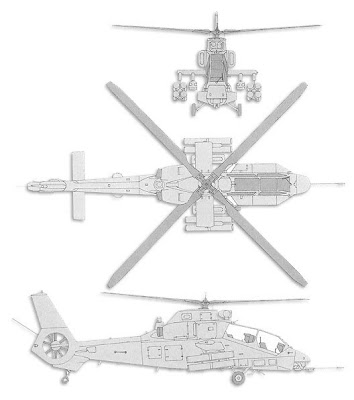
China's Z-10 attack helicopter (photo : Military Today)


In 2007, a Changhe Aircraft brochure on its then-new Z10 attack helicopters listed the power plant as the PT6C-67C engine manufactured by Pratt & Whitney Canada. The engine had been diverted from a civilian to a military aircraft.

Privately, U.S. officials are concerned that the civil EC175 medium-lift helicopter, which Eurocopter co-developed with China, could be put to military use.

One U.S. official in Paris noted that Eurocopter armed its EC145 to compete in the U.S. Armed Aerial Scout competition, and that China converted the company's Dauphin helicopter for submarine-hunting missions.

Another example is the Eurocopter EC120 Colibri Hummingbird, a single-engine light helicopter funded by China, France and Singapore and developed by a list of companies that includes CATIC, Eurocopter, Harbin and Singapore Technologies Aerospace. China now produces an HC120 variant of the Hummingbird for military training and police surveillance

Russia Makes Defence Proposals to Brunei

In October 2009, Sultan of Brunei visited to Russia and saw Russian-made air defense system and Ka-52 attack helicopter in action. He also visited a training center for special forces units, and watched a demonstration of Spetsnaz tactics. (photo : freerepublic)

Russia has once again expressed great interest in possible investment opportunities and areas of cooperation since His Majesty the Sultan and Yang Di-Pertuan of Brunei Darussalam's official visit to the federative republic in October last year.

In an interview with the Borneo Bulletin, the Ambassador of the Russian Federation to Brunei Darussalam, Victor Seleznev, shared several possibilities of Russian interest in the further development of Brunei Darussalam, especially in the areas of defence, energy, education, science & technology and tourism.

"We are now in good productive discussion with the defence ministry," revealed the ambassador.

"However, only some of the defence aspects of our cooperation have been pushed forward and that makes people forget that the scope of our cooperation which we are now preparing is much wider," he explained.

"But we've made proposals to the Brunei side and they are now thinking about how it should be done."

The Russian Ambassador was especially keen on possible training opportunities for Brunei's military in Russia.

"But naturally we must apply it to Brunei's necessities. We cannot impose, we can only propose and it's up to Brunei to choose what is useful for them," he told the Bulletin.

According to previous published news reports in the Borneo Bulletin last October, His Majesty had met with Russian President Dmitry Medvedev as well as officials from Russian state arms exporter Rosoboronexport for discussions on the possibility of future arms purchases where it was noted that "the military sphere is a promising direction".

Seleznev also spoke of the importance of the development of the dialogue with the Association of Southeast Asian Nations (Asean) and especially with the Asean Regional Forum (ARF).

"The ARF was really a great breakthrough for the region and we must congratulate Brunei and other Asean countries because since it was launched the conflicts in the region were greatly reduced and now not only do we not see many conflicts but there is no outside interference in the region. This is a great success for Asean and ARF," lauded Mr Seleznev.

The ARF currently is the first and most important governmental forum for multilateral security dialogue and cooperation in the Asia-Pacific. During His Majesty's state visit last year, it was announced that Brunei and Russia will co-chair a meeting at the ARF in July this year.

Meanwhile, the Ambassador also shared with the Bulletin Russian interest in the energy sector revealing that they are now "discussing possibilities of cooperation in oil and gas".

"We have very good and cheap technology that can help extract more oil and gas that have already been forgotten," he told the Bulletin.

"Sometimes (abandoned oil wells) still contain a significant percentage of oil and it was left because extracting is costly and (therefore) difficult to contract out," he explained.

"We have the technology to do this and if it is to be applied it is like finding another oilfield.

"We also have the technology for making power plants. We are making the proposals to Brunei and I hope they will study them and pick up whichever model that could be applied to Brunei," he said, citing a hydropower plant as a possible example for Brunei.

Another proposal is for possible Russian investments in Brunei's white sands. Previously South Korea and France have made similar proposals for the production of high-tech lens and glass respectively but neither proposal has materialised.

"Its current uses are limited but we can help Brunei develop it further," said Mr Seleznev, explaining that it has high applications in solar power stations or even cosmetics.

According to the Brunei Economic Development Board website, "abundant deposits of silica sand available in Brunei have been conducive to the development of a hub for solar cell and module production."

The Russian Ambassador went on to elaborate on other areas of cooperation in the areas of education and tourism that he hopes to see developed.

"We should also cooperate in areas of science and technology as well as education," he told the Bulletin.

"We are now discussing those possibilities with the relevant ministry and Universiti Brunei Darussalam, especially as His Majesty has expressed interest in training locals in specialised areas of engineering and specialised technologies," he revealed.

"After all, Russia has the resources and facilities to train your people in these professions," he added.

"We can also have brilliant cooperation in producing your medical staff. For example, in Malaysia and Indonesia many medical students are now training in Russia in many different fields of medicine," said Mr Seleznev.

Also a strong possibility is increased cooperation in the area of tourism as the ambassador revealed that he has already begun talks with representatives from the Brunei Tourism Board.

"I understand that not many Russians have yet to visit Brunei but I believe it would be very much interesting for (the Russians).

"You have health tourism as you have good medical institutions as well as eco-tourism which will attract many Russians," Mr Seleznev pointed out.

Describing Brunei as "great peace keepers", Mr Seleznev lauded the many positive roles that Brunei has played in the region and beyond.

"Brunei might be a small country but practically participating and establishing world peace. This is really a very big role played by Brunei, which sets a very good role for the world.

"We are very much expecting development through the mutual understanding and cooperation between Brunei and Russia," he asserted.

During His Majesty's sate visit to the Russian Federation last year, His Majesty had expressed satisfaction that the two countries have signed several bilateral agreements and Memoranda of Understanding and "will be signing a few more in the near future".

India's Light Combat Copter Makes First Flight

India's LCH attack heli (all photos : Indian Defence Forces)

As the helicopter taxied slowly along the airstrip, a little knot of designers and executives from Hindustan Aeronautics Ltd (HAL) watched silently, the sweat beads on their foreheads from more than just the Bangalore heat. March 29 had been selected for a landmark attempt: The first flight of the indigenous Light Combat Helicopter (LCH). Already a year late, and facing criticism for having gone several hundred kilograms overweight, the LCH had much to prove.

Attack helicopters involve the most complex aeronautical, stealth, sensor and weapons technologies. HAL’s state-of-the-art LCH aims to gatecrash an exclusive club of light attack helicopters that includes Eurocopter’s Tiger and China’s ultra-secret Zhisheng-10 (Z-10). In high-altitude performance, the LCH will be in a class by itself: Taking off from Himalayan altitudes of 10,000 feet, operating rockets and guns up to 16,300 feet, and launching missiles at UAVs flying at over 21,000 feet.

At 3.30 pm, the twin Shakti engines roared to a crescendo and the LCH pilots, Group Captains Unni Pillai and Hari Nair, lifted off the ground. The futuristic helicopter, all angles and armoured sheets, flew for a distance just a few feet above the runway; then cheering and clapping broke out as it climbed to 50 feet. Over the next 15 minutes, Pillai and Nair put the LCH through its first flight test, doing a clockwise and then an anti-clockwise turn, hovering motionless and circling the airport four times.

“It is a big day for all of us, especially those involved in the LCH’s design and fabrication,” Ashok Nayak, chairman and managing director of HAL, told Business Standard. “We were going to have the first LCH flight in December but, for one reason or another, it kept getting delayed.”
A feared predator in the modern battlefield, the attack helicopter is a key weapon system against enemy tanks. Once an enemy tank column is detected, attack helicopters speed to confront them, flying just 20-30 feet high to avoid radar detection with enemy rifle and machine-gun bullets ricocheting off their armoured sides. Hiding behind trees or a ridgeline, they pop up when the tanks are about 4 kilometres away to fire missiles that smash through a tank’s armour.

Excess weight has been the main reason for the delay in the LCH programme. The heavy armour needed for protection against enemy fire conflicts with the need for a light, highly mobile helicopter that can twist and dodge and hover stationary to allow pilots to aim and fire their missiles. The LCH was supposed to weight just 2.5 tonnes when empty; but the design team found that it actually weighed 580 kg more than that.


At lower altitudes, this would not be a significant drawback. But, at the LCH’s flight ceiling of 6,000 metres (almost 20,000 feet), this would significantly reduce the LCH’s payload of weapons and ammunition.

Last September, the chief of HAL’s Helicopter Complex, R Srinivasan, told Business Standard that the LCH’s weight would be progressively reduced over the first three Technology Demonstrators (TDs) of the LCH. “We will find ways of cutting down TD-1 by 180-200 kg; TD-2, will be another 100 kg lighter; and TD-3 will shave off another 65-75 kg. That would leave the LCH about 200 kg heavier than originally planned, but the IAF has accepted that.”

HAL chief Ashok Nayak today confirmed to Business Standard that this schedule was on track. “The weight reduction that we had targeted for TD-1, which flew on Monday, has been met. The second prototype, TD-1, which will make its first flight by September, will be lighter still.”

The Indian Air Force (IAF) has said that it needs 65 LCHs; the army wants another 114. If the development programme is not delayed further, the LCH will enter service by 2015-2016. To meet its needs till then, the Ministry of Defence floated a global tender for 22 attack helicopters. With only three companies responding, that tender was cancelled last year.

But HAL remains confident since most of the key technologies in the LCH — e.g., the Shakti engine, the rotors and the main gearbox — have already been proven in the Dhruv Advanced Light Helicopter, 159 of which are being built for the army and the air force.

Simultaneously, the LCH’s weapons and sensors are being tested on a weaponised version of the Dhruv. These include a Nexter 20 mm turret-mounted cannon, an MBDA air-to-air missile, and an EW suite from SAAB, South Africa. India’s Defence R&D Organisation (DRDO) is developing an anti-tank guided missile (ATGM) for the LCH. Based on the already developed Nag ATGM, the HELINA (or HELIicopter-mounted NAg) missile can destroy tanks from a distance of seven kilometres.

Turkey To Buy 9 European A129 Attack Helicopters


undefined

IANKARA - Turkey will launch urgent talks to buy nine A129 Mangusta attack helicopters from the Italian-British manufacturer AgustaWestland to fight separatist Kurds operating in an area near the country's borders with Iraq and Iran, a key Turkish official announced late Tuesday.


"In an effort to meet the urgent needs of the Turkish Land Forces Command and as part of the ongoing attack helicopter program, negotiations for the procurement of an additional nine attack helicopters will be launched with TUSAS," Defense Minister Vecdi Gonul told reporters after a meeting of the Defense Industry Executive Committee, Turkey's highest decision-making body on procurement.
TUSAS is the Turkish name for the Turkish Aerospace Industries, the prime contractor in Ankara's program to jointly manufacture at least 50 attack helicopters with AgustaWestland. The nine helicopters will come in addition to the 50 choppers to be jointly manufactured. The additional nine gunships to be procured are A129 Mangustas, a senior procurement official said.
The Defense Industry Executive Committee's members include Prime Minister Recep Tayyip Erdogan, Gonul, Gen. Ilker Basbug, chief of the General Staff, and Murad Bayar, head of Turkey's procurement agency. .
Bayar's office, the Undersecretariat for Defense Industries, and AgustaWestland signed a multibillion-dollar contract in 2008 for joint production of 50 T129s, a Turkish version of the A129.
The Kurdish separatist group, the Kurdistan Workers' Party (PKK), has killed scores of soldiers since it stepped up attacks on Turkish targets in the spring.
The Turkish Army operates six AH-1W Super Cobras and more than 20 earlier model Cobra helicopters, and military officials in recent years have voiced an urgent need for additional gunships to fight the PKK.
The T129s are expected to become operational by 2014. The latest announcement for additional gunships represents a stopgap solution until the first deliveries.

Bell Is building a New Demonstrator Helicopter OH-58D Kiowa Warrior


Bell Helicopter is building a new demonstrator aircraft to prove the OH-58D Kiowa Warrior can remain a viable, long-term option even as the US Army seeks a huge boost in performance.

Inside Bell's Xworx advanced programmes group, a re-acquired 206B1 JetRanger is being heavily modified. First, the aircraft will be converted into the OH-58D design on which the 206B is based.


Then Bell's staff will install a new engine with 50% more power than the 650shp Rolls-Royce Model 250 CR30. Honeywell has provided a 975shp HTS900-2, the engine originally built to power the now-cancelled Bell ARH-70 armed reconnaissance helicopter.

With the extra power, Bell's Xworx team hopes to show the army that the OH-58D can be upgraded to meet the army's potential demand for an aircraft that can hover out of ground effect at 6,000ft on a 35ºC (95ºF) day.


Michael Miller, executive director of Bell's military aircraft operations, believes the engine upgrade will allow the Kiowa Warrior to meet the army's target for hover at altitude. However, integrating a more powerful engine may not help the helicopter achieve the army's possible endurance goal of 2h45min.

"I don't think it will hit that" performance target, Miller says.
But Bell wants to prove that the OH-58D has the growth capacity to approach the army's emerging needs for a more powerful scout helicopter.


Integrating the HTS900-2 engine requires other major changes for the OH-58D, Miller says. For the demonstrator, Xworx is integrating the transmission from the 407 and the tail rotor from the 427 helicopters. The engine cowling for the HTS900-2 also is significantly larger.

Miller declined to provide a timeline for first flight of the demonstrator. A tour of the aircraft on the shop floor at Xworx showed that the cabin structure is nearly complete, but the engine, power system and cockpit systems have not yet been integrated.

The full-scale demonstrator - a first for Bell in several years - will join several candidates for a possible future army contract.

The army is still considering options for an armed aerial scout (AAS) helicopter that may replace the OH-58D. An analysis of alternatives is scheduled to be completed by April 2011.

The Kiowa Warrior remains in heavy demand in operations in Afghanistan and Iraq, but the type's limits are showing. The OH-58D was introduced in the early 1980s as an interim scout helicopter, but two attempts to replace it with the RAH-66 Comanche and ARH-70 Arapaho have failed.