Showing posts with label Libya. Show all posts

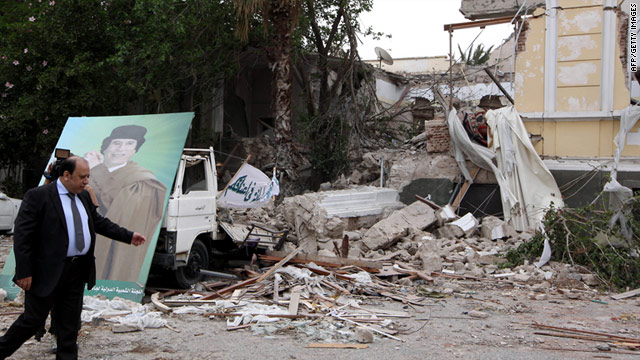
Rebels seize Gaddafi compound in Libya - media

Rebels have overrun the fortified compound of longtime Libyan leader Muammar Gaddafi in Bab al-Azizya in Tripoli following intense fighting with pro-Gaddafi forces, the Al Jazeera TV network reported.
Rebels announced that they gained control of much of the capital on Tuesday, but Gaddafi's whereabouts are still unknown.
An uprising which began in Libya in mid-February against Gaddafi's forty-year rule has already claimed thousands of lives. An international military operation "to protect civilians" in Libya began on March 19 following a UN resolution and has been extended until late September.


A US Air Force F-15E fighter jet crashed in Libya overnight after a mechanical failure but its crew was safe, a spokesman for the US military Africa Command said Today.


Libyan rebels rescued the pilot after he ejected from the warplane, which came down near the eastern city of Benghazi, Britain's Daily Telegraph newspaper reported on its website.

Spokesman Vince Crawley declined to give the location of the crash and also would not say how the rescued crewman was picked up or where he was taken.

Another spokesman for the Stuttgart-based Africa Command said later the second crewman had also been safely rescued, and both crew members had suffered only minor injuries after ejecting from the aircraft.

The aircraft, based out of England, was flying out of Aviano Air Base in Italy when it experienced an equipment malfunction over northeast Libya, a military statement said.

The Telegraph web site showed local Libyans inspecting the charred wreckage of the plane.

Western forces carried out a third night of air raids overnight aimed at protecting civilians from forces loyal to Libyan leader Muammar Gaddafi.

Russia Eyeing $3 bln in New Arms Contracts

Russia, the world's second largest arms exporter, may seal three new orders worth more than $3 billion for fighter aircraft over the next year, the top Russian defence think tank CAST said on Thursday.

The new orders would be a boon to an industry which has watched its export market shrink after the Arab Spring revolutions and been criticised at home by President Dmitry Medvedev over the quality of its weapons systems.
India is looking to sign a new $2 billion contract for 40 Sukhoi-30MKIs, according to CAST data, and the Russian Defence Ministry itself may soon sign a deal for 24 Mikoyan-29Ks to renew the ageing fleet on its sole aircraft carrier.
"There is a very strong chance that the Indian air force may sign a contract to buy up to 40 Su-30MKI fighters, even by the end of this year," CAST Director Ruslan Pukhov said.

The Su-30MKI was developed by both Russia and Hindustan Aeronautics, and travels at 1,300 miles per hour at altitude.

"They can't get enough of Russian arms," Pukhov said of India.

India, cautiously watching regional rival China's growing military might, has been the top importer of Russian arms, and the two countries are working on a fifth-generation fighter in a deal reported to be worth around $35 billion.

Delivery of the supersonic jet is expected to begin in 2017.

A Russian fighter was cut from the shortlist in an $11 billion fighter tender in April in favour of two European variants.

"There was a political component to their decision. They knew that they were buying too many arms from the Russians and they knew for diplomatic reasons they had to start balancing out their suppliers," said Pukhov.

The $960 million contract for 24 Mi-29Ks, expected to be signed next year, is for Russia's aircraft carrier, which currently relies on outdated Su-33 planes.

Another deal will be for six Yak-130 light attack aircraft originally intended for Libya before the United Nations imposed an arms embargo on Tripoli, cutting Moscow off from $2 billion in signed deals and another $2 billion in potential contracts.

The top customer for the light attack aircraft is Kazakhstan which is trying to boost its regional clout, Pukhov said, citing defence industry sources.

Russia's arms exports rose to a near-record $10 billion last year and are expected to stay around there for the next few years -- though Middle East violence has since threatened those forecasts.


Read More AT:
http://af.reuters.com/article/commoditiesNews/idAFLDE7730H020110804?sp=true

Libyan army "could continue fighting for weeks"

undefined

Moammar Gaddafi retains enough military might to resist the international intervention for several weeks or even months, according to a Swiss military expert.

Alexandre Vautravers, editor of the Swiss Military Review and head of the international relations department at Webster University in Geneva, tells that the Libyan army still has significant strength in numbers of tanks, assault vehicles, weapons and troops.After 6 nights of air strikes, discord about the aims of the mission amongst its allied leaders is intensifying, and it is proving harder than expected to establish relations with the leaders of the rebel-led National Transitional Council.

There was a lot of wishful thinking about this rebellion, according to Vautravers, who points out that popular support for the uprising is not comparable to what was seen in Tunisia or Egypt. The most favourable estimates say that only about 35 per cent of the population has actually rebelled against the Gaddafi regime.

The US says the mission to destroy Gaddafi's air defences and impose the no-fly zone is nearly completed. What happens next?

Alexandre Vautravers: The US military command has said that since the first bombs were dropped over Libya, there have been no aerial or ship movements by the Libyan armed forces. [But] military aviation has never played a decisive role in the attacks against the Libyan population. The harm that was really perpetrated against the population was done by other types of weapons – shelling from boats or artillery or heavy weapons – rather than by aviation. There is a bit of misunderstanding about what this no-fly zone was intended to achieve.

Gaddafi loyalists are continuing to attack towns in Western Libya, in particular Misrata and Zintan. Can the rebels effectively fight back without the support of ground troops?

A.V.: There are two very different kinds of forces that are fighting each other. The Libyan military is a relatively coordinated armed force. Certainly for a number of weeks it can continue fighting at the rate it is now. The Libyan military has very substantial stocks of military equipment, weapons kits and an arsenal of munitions. It has some 2,200 battle tanks, over 1,000 infantry fighting vehicles. The troops also have very frequent rotations. The mercenaries come from a number of tribes in sub-Saharan Africa, Morocco or from Eastern Europe and have the same kind of turnover. The troops are not going to be worn down in one or two months, they are rather going to be strengthened by their fighting experience. The rebellion has managed to seize a number of military weapons, barracks and munitions depots. But they don't have the coordination or training, or the command and control capabilities.

How important are relations with the National Transitional Council (NTC)?

A.V.: I think that establishing a relationship between Western forces and these combatants has proven more difficult than was originally planned. The NTC is made up of people who don't necessarily have a very recommendable track record either. We are talking about different tribes, about a different part of the country. Some people have referred to this more as a 'coup d'état' than a proper revolution. The relationship or the contacts that have been made with this council or with rebel fighters have been laborious at best.

Should the ultimate goal of the intervention be to remove Gaddafi? What is the risk of stalemate if he isn't removed?

A.V.: A lot of people will have very strong words about a UN resolution to protect the population against human rights abuses, against military attacks on unarmed civilians and so on. The problem is that when you have to get down to business and get your hands dirty a lot of countries have second thoughts. There is a kind of hypocrisy around the question of humanitarian military intervention or the responsibility to protect. The person who has best captured this is President Obama by saying you're damned if you do, damned if you don't.

Obama says that the US will cede power to a British or French-led NATO coalition "within days". How do you think this will play out?

A.V.: I find it fascinating that so much is being talked about with regards to this coordination because it's really a non-issue. The command and coordination is Nato. It may not have the Nato logo on it but for all purposes concerned it is a Nato operation. Even the planning to a great extent has been done by Nato staff. But on the questions of leadership, different countries have different aims or interpretations of the mandates.

The confusion at the political level about the aim of the mission implies that there is no exit-strategy. Can we define an exit strategy at this point?

A.V.: The exit strategy is going to be similar to many kinds of humanitarian interventions. We have seen this in Iraq and in Afghanistan where the US has gone in, handed over to Nato then to the European Union, then handing it over to a coalition of forces then handing it over to the local authorities. Most probably there will be this type of cascade that is going to take place.


How important is the role of the Arab League in the intervention?
A.V.: The Arab league of today is a very different kind of institution and may not speak with as much as a unified voice as it did ten years ago. The situation of many of these governments and regimes has changed. The links with  western powers and international organisations are yet to be established by many of these transitional regimes. I'm not sure that we can expect to have a firm stance on the part of the Arab League in this situation. The Qataris have sent six aircraft which are now based in Cyprus, completely out of the way. It is a very symbolic presence. The United Arab Emirates has committed ships and transport aircraft and they are interested in being supportive of the humanitarian action.

After Gaddafi, Democracy or Jihadists?


by Walid Phares, Ph.D.

We all agree that Colonel Gaddafi is a dictator, that he supported terrorism against the U.S. and France, was responsible for the tragedy of PanAm 103, that he funded, armed and trained radicals in many African countries such as in Mali, Mauritania, Niger, Senegal, Haute Volta, and in a few Middle Eastern countries, including Lebanon. We all are aware that his regime oppressed his people and tortured and jailed his opponents for four decades. I observed Gaddafi ruling Libya unchecked during and after the Cold War, before and after 9/11, and he was received by liberal democracies as a respectable leader.

My first question is: Why has the West been silent so long and why is it so late in taking action against this dictator? Of course it had to do with oil. Western elites were morally and politically encouraging him by buying his oil and empowering him with endless cash as Libyan dissidents were dying in jails.

Now, as missiles are crushing Gaddafi's air defense systems and tanks, Western governments should be invited for serious self-criticism for having enabled this regime to last that long. Squeezing or even defeating Gaddafi should prompt a comprehensive review of past decades of Western policies towards this regime and its abuses of human rights. The military operation should not end with the departure of Gaddafi from power. It must open the door for an examination of US and European policies that have aligned themselves with Petrodollars interests for over half a century. Such self-criticism was supposed to start with the removal of the Taliban and Saddam Hussein, but unfortunately, it hasn't taken place yet, precisely because of the mega-influence inside the West and the United States by powerful lobbies representing the interests of OPEC, the Arab League and the OIC.

Besides, questions should be raised about the Arab League and OIC endorsement of an action against Gaddafi's regime. Where were they for decades, when the Libyan dictator used to seize the microphone on their platforms and blast the very democracies they implored to act against him? These organizations catered to the interest of regimes they now are calling for sanctions against. Mr. Amr Moussa, the current secretary general of the Arab League, rises against Gaddafi after having supported him for years, while the latter was oppressing his own people.

In my book, The Coming Revolution: Struggle for Freedom in the Middle East, I call all these regimes and organizations a "brotherhood against democracy." They have supported each other against democratic movements and minorities everywhere in the region. From Sudan to Lebanon, from Iraq to Libya, the regional organizations were at the service of these regimes, not of the people. As these revolts are ongoing, these inter-regimes' organizations must be criticized and eventually reformed. Last year, the Arab League and OIC were endorsing Libya's role in the UN Council on Human Rights. Egypt, Tunisia and Libya's representatives at the Geneva UN body were shutting up the voices of Libyan dissidents just a few months ago. Now that the uprisings have crumbled the regimes in Cairo and Tunisia, and Tripoli's ruler is cornered, the negative impact these inter-regime organizations have on dissidents and human rights on international levels must be exposed and their future representation comprehensively reformed.

Research confirms that many jihadists have been recruited from Libya, and particularly from its eastern provinces. Besides, Western policies towards Gaddafi's regime were incoherent. They should have supported true democratic forces and uprisings in the region from Iran to the Arab world.

In short I would have advised for a different set of US global strategies in the Middle East. We should have backed the Iranian Green Revolution in 2009, the Cedars Revolution as it struggles against Hezbollah, and Darfur in its liberation drive against the Jihadist regime in Khartoum. In Egypt, we should have clearly sided with the secular youth and Copts, as they asked for a new constitution. In Iraq, we should have been clear in supporting reformist and secular forces.

As far as Libya is concerned, removing Gaddafi is not the question. That should have been done years ago on the grounds of abuse of human rights. The question is who will come next? Clearly, the agenda of the Benghazi leadership is not clear. We know there is a layer of former bureaucrats, diplomats, intellectuals and military dissidents with whom partnership is possible and should be encouraged. But there is another layer below the surface which is made of Islamists, Salafists and in some cases Jihadists.

From a simple observation of the latter's narrative on al Jazeera, one major component of the opposition is an Islamist force aiming at taking over in Tripoli. Hence, Washington must partner with the secular-democrats and warn that it won't endorse replacing Gaddafi's Jamahiriyya with a Jihadi emirate. Why aren't the most liberal Libyan dissidents received in Washington and made visible? The US and NATO military has been tasked to open the highways to Tripoli for the opposition, but we need to insure that on that highway we won't see the democracy groups eliminated by the next authoritarians.


— Professor Walid Phares is a Professor of Global Strategies and an advisor to the Counter Terrorism Caucus of the US House of Representatives. He is the author of The Confrontation: Winning the War against Future Jihad.

Visit Dr. Phares on the web at www.walidphares.com.

Gadhafi: 'We will not surrender, we will not give up'


Libyan leader Moammar Gadhafi vowed Tuesday that "we will not surrender," even as NATO airstrikes bombarded his compound in Tripoli.

"I am now speaking as planes and bombs fall around me," Gadhafi said in a live audio broadcast on state television. "But my soul is in God's hand. We will not think about death or life. We will think about the call of duty."

At least 35 loud explosions rocked Tripoli around midday Tuesday as NATO targeted a military base and Gadhafi's compound, state television reported.

The compound was under "intensive continuous bombardment," according to state TV, which reported buildings and infrastructure in the area were destroyed in the strikes.

"We will not surrender, we will not give up," Gadhafi said. "We have one option -- our country. We will remain in it till the end. Dead, alive, victorious, it doesn't matter."

The blasts Tuesday, and others Monday that Libyan officials said hit state television buildings, elicited heated responses from a government spokesman.

"We believe NATO understands that its military campaign is failing miserably," said Musa Ibrahim, the government spokesman. "No one has the right to shape Libya's future except for Libyans."

Ibrahim said Tuesday's morning blasts hit the popular guard compound and revolution compound, which are military barracks near Gadhafi's Bab al-Aziziya compound.

Ibrahim said the attack on the television network killed two people and injured 16.
NATO disputed the account.

"We did not target or hit the Libyan broadcast facilities. What we did target was the military intelligence headquarters in downtown Tripoli," the alliance said. "The story coming from Libyan officials that we targeted and hit the state broadcaster's building is bogus."

The back and forth between Libyan officials and NATO continues a public relations war between the two sides.

Libyan officials have continually charged that NATO airstrikes have damaged civilian facilities and killed hundreds of civilians.

NATO Secretary General Anders Fogh Rasmussen has said recently that his forces have made "significant progress" in its U.N. Security Council mandate to protect Libyan civilians.

Japan Freezes $4.4 bln Of Libyan Strongman Gaddafi's Assets


After the UN sanctions against the Libyan dictator, every country has been taking some or the other step to freeze his assets. Thus this action comes as no surprise that Japan has frozen $4.4 billion on financial accounts of Libyan leader Muammar Gaddafi and his supporters, Japan Today said on Saturday.

In March, Japan included 18 officials and organizations of the Gaddafi regime and the Central Bank of Libya into the sanctions list. The United States has frozen about $30 billion of Libyan assets along with the EU and Switzerland.In May, U.S. Secretary of State Hillary Clinton said Washington would use part of the frozen funds in the interests of Libyan people.

President Medvedev Of Russia To Send Envoy To Libya


Mikhail Margelov
A Russian presidential envoy for Africa, Mikhail Margelov, said he would go to Libya's Benghazi on June 6 for talks with the Libyan opposition.

At a Group of Eight (G8) meeting in France last week, President Dmitry Medvedev said he expected Margelov, who also heads the foreign relations committee of the Russian upper house, to meet both with the Libyan opposition and authorities during his visit.

"We value relations with Libya and the Libyan people," Margelov said. "The Russian president firmly supports sovereignty, independence and territorial integrity of Libya."

Speaking after the G8 summit of seven European countries and Russia in Deauville on May 27, Medvedev said Muammar Gaddafi's regime had lost its legitimacy and the Libyan leader must leave his post.

Medvedev said Russia would not grant asylum to Gaddafi adding that the international community no longer considered him the Libyan leader.

The revolt which began in mid-February in Libya against Gaddafi's forty-year rule has already claimed thousands of lives, with Gaddafi's troops maintaining their combat capabilities despite NATO airstrikes against them.

As reported earlier Kremlin was approached by UK and USA to mediate for them in the Libyan crisis.

President Dmitry Medvedev's spokeswoman said on 26th of May."In every bilateral meeting such a request was heard," press secretary Natalia Timakova told journalists after Medvedev had bilateral talks with U.S. President Barack Obama, French President Nicolas Sarkozy and British Prime Minister David Cameron on the sidelines of the G8 summit in Deauville, France.
"In the bilateral meetings, everyone thanked the president for his constructive position on Libya. More than that, in practically all the discussions it was requested that Russia undertake a mediation mission for a settlement in Libya," she added.

Algeria, Libya set to buy Russian Pantsir-S1 short-range air defense systems.


Algeria and Libya are ready to buy Russian Pantsir-S1 short-range air defense systems, deputy head of the Russian Military-Technical Cooperation Service Vyacheslav Dzirkaln said on Wednesday.

"The new system has shown high efficiency. Algeria and Libya have shown interest. Syria has already bought these systems in the past," Dzirkaln said, adding that other potential customers were likely to appear.
Earlier in March the Russian press said Algeria was planning to buy 40 Pantsir-S1s for $500 million.
Several Russian papers also reported that Russia had signed a $734-million contract with the United Arab Emirates (UAE) in 2000 on purchasing 50 Pantsir-S1s.
Dzirkaln confirmed the reports and said Russia would finish delivering the Pantsir-S1's to the UAE this year.
Pantsir-S1 is a short-to-medium range combined surface-to-air missile and antiaircraft artillery system manufactured by the Tula-based Instrument Making Design Bureau (KPB).
It is designed to protect point and area targets and carries up to 12 two-stage solid-fuel surface-to-air missiles in sealed ready-to-launch containers.
The system also has two dual 30 mm automatic cannons that can engage targets at a range of up to 4 km.
ABU DHABI, June 2 (RIA Novosti)