Showing posts with label Japan. Show all posts

North Korea Updates A Cold War Classic:RSM-25


Japanese intelligence believes that North Korea is close to putting into service their new RSM-25 (or Musudan) ballistic missile. It was only last year that a military parade in North Korea featured the first public appearance of the long rumored RSM-25 missile. This is a variant of the Russian SS-N-6 submarine launched missile. The North Korean version is believed to weigh 20 tons and have a range of over 3,000 kilometers. The Japanese believe the range of the North Korean missile may be as much as 4,000 kilometers. It is believed that the North Korean version, using solid fuel rockets, was tested successfully two years ago.
The SS-N-6 is a 1960s vintage ballistic missile, and is known in Russia as the R-27. SS-N-6 is a NATO code name for the R-27. This was Russia's first true submarine launched ballistic missile (SLBM), and sixteen of them were carried in Yankee class SSBNs (missile carrying nuclear submarines.) The 12 ton R-27 had a range of 2,800 kilometers and used storable liquid fuel. This means it can be ready for launch in less than half an hour.
After the R-27 was replaced by more modern missiles in the 1970s, the missile continued to be used for scientific research until 1990. By that time, 492 R-27s had been launched, 87 percent of them successfully.
It would be very embarrassing for the Russians if someone had illegally exported SS-N-6/R-27 missiles to North Korea. It is more likely, and was been reported a few years ago, that the Russian organization that designed the R-27   illegally sold the plans to North Korea. This was supposed to have happened sometime in the 1990s, and the main reason for the deal was so that North Korea could obtain the R-27 missile guidance technology. The Russians kept improving the guidance system of the R-27 through the 1980s, while the North Koreans were desperate for missile guidance technology. But it appears that the North Koreans built at least one R-27, and may have incorporated R-27 technology in some of their other long range ballistic missiles. The North Koreans were apparently pleased with the R-27 design, and spent the time and effort to change it so that Musudan used more reliable solid fuel rocket motors, than the original liquid fuel ones.
Strategy Page.

Russian Military Build-up in the Pacific May Not be Aimed at Japan

Russia seems to have found a place to deploy its two most modern French-built assault helicopter-carrying ships – in the Far East to help defend the Kurile Islands. The first Russian Mistral will be built by the end of 2013, the second by 2015 and together will reportedly cost some 1.4 billion Euros ($1.9 billion) (RIA Novosti, February 9). Defense Minister, Anatoliy Serdyukov, earlier this month inspected the Russian garrison (the 18th machinegun/artillery division) entrenched in Cold War era bunkers on the southern Kurile Island of Kunashir (Japanese name –Kunashiri) and Iturup (Japanese name –Etorofu), under Russian rule since 1945 and claimed by Japan together with the Habomai islets and Shikotan as the so-called Northern Territories. Serdyukov promised to reinforce and rearm the Russian garrison (ITAR-TASS, February 4). After that a flurry of controversial statements followed, apparently, indicating disagreement about concrete details of the planned military build-up.

One “high-ranking source in the General Staff” told the semi-official news agency, Interfax, that the 18th division will be transformed into a brigade, though the number of service personnel will remain approximately 3,500 and that there was no need to send to the Kuriles long-range S-300 or S-400 antiaircraft missiles. According to Army-General (retired) Yuri Yakubov, the former commander of the Far East Military District, the garrison of the South Kurile Islands already has relatively modern T-80 tanks, but it needs new light armored vehicles and additional helicopters (Interfax, February 15).

Another “high-ranking source in the General Staff” told the state-run RIA Novosti news agency: “There is no need to reshape the 18th division. New brigades are intended for maneuverable warfare, which on the South Kuriles is absolutely impossible. The 18th division is perfectly formed as an entrenched fortress garrison, but it will be reinforced by an air-space defense missile brigade, possibly with S-400 missiles” (RIA, Novosti, February 15).

Of the 45 permanent readiness antiaircraft missile regiments in the Air Force Antiaircraft Missile Troops presently only one with S-400’s has been deployed to defend Moscow. This week a second S-400 regiment officially received its missiles and other equipment. The new regiment will have two divisions, each with eight launchers, and each launcher has four missile tubes. Speaking at the inauguration ceremony of the second S-400 regiment, the chief of the Air Force Antiaircraft Missile Troops, Major-General Sergei Popov, told journalists: “it does not make sense to send S-400’s to the South Kuriles” adding that shorter range Buk missiles could do the job. According to Popov, during the Cold War an antiaircraft radar regiment was deployed on the South Kuriles, a fighter regiment on the nearby Sakhalin Island and “its planes could intercept any target in minutes.” Of course, Popov added, if orders are given, the S-400’s will be sent (RIA Novosti, February 16).

The threat of Japanese soldiers storming the Kurile beaches to retake the Northern Territories by force seems remote, but revamping the Russian garrison seems sure to go ahead. Serdyukov has announced the airstrip at the Buryvestnik airbase on Iturup will be extended to receive heavy Il-76 transport planes to facilitate troop reinforcements in a time of conflict (Interfax, February 9).  During a meeting with Serdyukov and the minister for regional development, Viktor Basargin, Medvedev pledged to fully support efforts to boost military capabilities and civilian infrastructure in the Kuriles (www.kremlin.ru, February 9).

In 2006, a special federal program was approved to spend 18 billion Rubles ($612 million) from 2007 to 2015 to develop civilian infrastructure in the Kuriles. According to Basargin, 9 billion rubles ($306 million) have been spent and the Kurile federal program “is one of the few that were not cut during the financial crisis.” Basargin requested an additional 8 billion rubles ($273 million) to add to the Kurile program, including 1.5 billion ($51 million) in 2011 and Medvedev agreed. Officially, the Russian population of the South Kuriles is 16,400 which apparently include several thousand military personnel and families (some 3,500 in the 18th division plus the air force, the navy and border guards). The Kurile federal program has been tentatively increased to 26 billion rubles ($885 million) and may exceed $1 billion – according to Basargin, the governor of Sakhalin to which the Kurils administratively belong, has asked for an extra 13 billion rubles ($443 million) (www.kremlin.ru, February 9). This does not include defense spending on rearming and developing military infrastructure in the South Kuriles, the building of a facility to harbor the Mistral assault ships on the Russian mainland and other costs. Taking into account the sparse population of the South Kuriles, the overall investment is huge and clearly reflects a massive strategic commitment overruling other urgent infrastructural problems in Russia at a time when the federal budget is in deficit.

Russia’s First Deputy Defense Minister, Army-General Nikolai Makarov, told journalists: “We need such ships [Mistrals] to defend the Kurile chain that is now defenseless. The army was there before, but now there is no one and we need mobile capabilities to bring in forces rapidly to close gaps in time of need” (Interfax, February 9). But the South Kuriles are already defended and reinforced. Makarov seems to mean the Kurile Islands north of Iturup that Japan does not claim, which housed military bases during the Cold War, and are now abandoned. With the exception of the northern island of Paramushir with reportedly 2,400 inhabitants; the Kurile Islands from Iturup to Kamchatka are uninhabited. It seems the deployment of the Mistrals in the Pacific Fleet is not against Japan, but that the US in preparation for conflict could “leap-frog” the fortified South Kuriles into the undefended and uninhabited central Kuriles to invade the Sea of Okhotsk. To defend the Sea of Okhotsk as a safe haven for nuclear strategic submarines, the Russian military is deploying capabilities to reinforce the entire island chain.

The South Kurile visits by Medvedev and other top officials that have provoked the present diplomatic spat with Tokyo may have been mainly high-level inspections to see that vast federal infrastructural expenditures have not been all stolen, as often happens in Russia. Japan is not a first-class priority in Russian politics or strategic planning. The strategic build up in the Kuriles and of the Pacific Fleet capabilities may not be aimed at Japan or China per se, but the US – Russia’s true present number one strategic concern.

Japan Stealth Jet Prototype Set To Fly In 2014

Japan is looking to join the United States, China and Russia with a stealth fighter that senior Japanese air force officials say can be ready for a prototype test flight in just three years, significantly upping the ante in the intensifying battle for air superiority in the Pacific.

The prototype will likely be able to fly in 2014, Lt. Gen. Hideyuki Yoshioka, director of air systems development at Japan's Ministry of Defense, said in an interview with The Associated Press.

He said Japan has put 39 billion yen (473 million) into the project since 2009, after it became clear the United States was not likely to sell it the F-22 "Raptor" America's most advanced fighter jet because of a congressional export ban.


"We are two years into the project, and we are on schedule," Yoshioka said on Monday.

Yoshioka stressed that a successful test flight of the prototype, dubbed "Shinshin," or "Spirit," does not mean Japan will immediately start producing stealth aircraft. The prototype is designed to test advanced technologies, and if it is successful the government will decide in 2016 how to proceed.

Japan is feeling the pressure of a regional dogfight over fighter superiority.

"If the countries surrounding Japan have stealth capabilities, Japan will need to develop those capabilities itself to ensure our own defense," said Col. Yoshikazu Takizawa of the Defense Ministry's Technical Research and Development Institute.

Japan relies to a large degree for its defense on its alliance with the United States, which has a significant number of fighters and other aircraft, along with some 50,000 troops, stationed around the Japanese archipelago.

Japan Launches F-X Fighter Jet Competition

Japan has formally launched its F-X fighter competition by sending a request for proposals to three potential bidders.

Boeing and Lockheed Martin have confirmed a US government representative has received Japan's RFP on behalf of the F/A-18E/F Super Hornet and F-35 Lightning II, respectively.
A UK representative is also understood to have picked up the RFP for a possible bid by the Eurofighter Typhoon. 

Each bidder should receive a copy of the solicitation soon.
Japan has released the RFP just a few weeks after the country was hit by an earthquake, tsunami and nuclear crisis, leaving an estimated 26,000 people dead and public safety still at risk.

Damage caused by the disasters may have included an entire squadron of 18 Mitsubishi F-2B trainers, at least some of which were engulfed by seawater when the tsunami struck Matsushima air base.

Meanwhile, Japan has already started decommissioning its fleet of ageing McDonnell Douglas F-4 Phantom IIs, which it plans to replace with the F-X fighter.

Tokyo had originally expressed interest in importing the Lockheed Martin F-22A Raptor, but the US Congress decided not to waive or rescind the export ban on the fifth-generation air superiority fighter.

Instead, Japan has launched the F-X competition while funding internal development of the ATD-X stealth demonstrator.

First Flight OF Japanese Stealth Fighter ATD-X in 2014

Tokyo has reaffirmed its plan for a 2014 first flight of its experimental Mitsubishi ATD-X Shinshin stealth demonstrator, while it also considers three fighters for its F-X requirement.

"The first flight of the ATD-X is scheduled in Japan fiscal year 2014," said Japan's defence ministry.

"The ATD-X is a trial product of a high-manoeuvrability stealth aircraft adopting various state-of-the-art technologies that may be applied to future fighters, and confirm and verify the practicality and operational effectiveness of systems under various flight conditions," said the ministry.

"It is also intended for the study of air defence against stealth fighters that might be deployed in the neighbouring region in the future."

 
Japan unveiled the first full-sized mock-up of the ATD-X at Japan Aerospace 2008. Many observers, noting the immense costs and risks in developing an indigenous fighter, have speculated that the project was a bargaining chip to help Tokyo gain access to the Lockheed Martin F-22 Raptor, which Washington steadfastly refused to sell to its Pacific ally.

Meanwhile, the Boeing F/A-18E/F Super Hornet, Eurofighter Typhoon and Lockheed F-35A Lightning II are vying for the F-X requirement to replace Japan's McDonnell Douglas F-4 Phantoms. Tokyo issued a long-awaited request for proposals for the deal in April.

According to Tokyo's mid-term defence programme for the years 2011-15, the Japan Air Self-Defence Force has initial plans to procure 12 aircraft, with the final number yet to be determined. At a media briefing at the Paris air show, however, Boeing said the F-X requirement is for 42 aircraft.

Boeing added that it elected to offer the Super Hornet as opposed to a variant of the F-15 because Japan seeks a diversity of fighter types. The country operates a large force of F-15Js, but was concerned about readiness in the event of a problem with a specific type of aircraft.

Under F-X, substantial parts of the aircraft selected will be produced in Japan. Both Boeing and Lockheed have a long history of industrial co-operation with Japan on fighter programmes, while Eurofighter is a newcomer.

Tokyo expects proposals to be submitted by the end of September. The defence ministry said it will request that funds for the F-X purchase be appropriated for FY2012, with the aim of inducting the aircraft in 2016


U.S. Military Chief 'Open' To New Ideas On Japan Base


WASHINGTON - The head of the U.S. military said on June 1 that he was open to ideas on resolving a long-running row with Japan over bases after three senators called the two governments' agreement infeasible.

"I think we need to be as open as we possibly can to solutions now," Adm. Mike Mullen, the chairman of the Joint Chiefs of Staff, told a breakfast with reporters.

Sens. Carl Levin, John McCain and Jim Webb last month called for the United States to rethink base realignment plans in East Asia due to political opposition in Japan and cost overruns in both Japan and South Korea.

Japanese and U.S. officials earlier dismissed the proposal, saying that the plan worked out in 2006 was the best approach and would reduce troop numbers on Okinawa Island, where tensions with local residents have been frequent.

Mullen, whose term ends in September, did not comment specifically on the senators' proposal but said that the United States needed to be mindful both of costs and the political situation in Japan.

"This thing's been discussed for 15 years. There have been 20 different kinds of solutions that I've seen - all of them are difficult. So I think we have to be realistic here," Mullen said.

Any solution needs to preserve "the kind of influence and stability that our presence in that part of the world has done for 60-plus years, and at the same time recognize limitations and that there are needs on both sides."

The senators said that Japan needed to focus on reconstruction from its massive March 11 earthquake and not be distracted by the base dispute, which contributed to the resignation of a prime minister, Yukio Hatoyama, last year.

Under the 2006 plan, the United States would move the flash point Futenma base out of a crowded urban area and to an isolated stretch of beach elsewhere on Okinawa.

Some Okinawan activists have demanded that the base be removed from the island completely. The senators said Futenma was needed for security but that its functions could largely be shifted to Okinawa's existing Kadena Air Base.

The United States stations 47,000 troops in Japan under a post-World War II security treaty, with half in Okinawa. The 2006 plan aims to shift 8,000 Marines and their families from Okinawa to the U.S. territory of Guam in 2014.

Japan Freezes $4.4 bln Of Libyan Strongman Gaddafi's Assets


After the UN sanctions against the Libyan dictator, every country has been taking some or the other step to freeze his assets. Thus this action comes as no surprise that Japan has frozen $4.4 billion on financial accounts of Libyan leader Muammar Gaddafi and his supporters, Japan Today said on Saturday.

In March, Japan included 18 officials and organizations of the Gaddafi regime and the Central Bank of Libya into the sanctions list. The United States has frozen about $30 billion of Libyan assets along with the EU and Switzerland.In May, U.S. Secretary of State Hillary Clinton said Washington would use part of the frozen funds in the interests of Libyan people.

Why the F-22 Matters for Japan


Two critical political "dogfights" are underway in Washington that could help determine the speed with which Japan may have to make a critical decision on whether to acquire a decisive means of deterrent, quite possibly a nuclear deterrent.
The first dogfight is between the U.S. Congress and the Obama Administration over whether to continue production of the Lockheed-Martin F-22 Raptor 5th generation super-fighter. A second and related dogfight is whether a group of Congressmen led by Senator Daniel Inouye of Hawaii can persuade Congress to change a law preventing foreign sales of the F-22, so that Japan could then purchase an export version of this fighter.
Amid the constantly competing headlines out of Iraq, Afghanistan, Iran, Latin America, Israel and Russia, very few in Washington are aware of the F-22’s political dogfights, and very few are thinking of the consequences of failing to sell the F-22 to Japan. At first glance, the F-22’s chances of political survival are not great. President Barak Obama and Secretary of Defense Robert Gates have made ending F-22 production at 187 fighters their most important policy change to prove they can control U.S. military spending and strategy. Gates contends that 187 Raptors is enough for the U.S. Air Force and that money is instead needed to fight "the wars of today" not "the wars of tomorrow." However, support for the F-22 remains strong within the U.S. Air Force, even though Gates fired the USAF leadership in 2008 in part for its support for the F-22.
The U.S. Senate has only approved 7 more F-22s while the U.S. House of Representatives approved 12 more—but only after a Republican amendment added to a bill at 3AM in the morning. Top Democrat and some Republican leaders in the U.S. Congress are rising to oppose the additional Raptors and immediate threats to veto the Defense funding bill by the White House and by Gates prove they are serious about defending their policy prerogatives.
Senator Inouye’s attempt to reverse a 1998 law barring export of the F-22 may stand a greater chance of passage, if only because it does not push for continued F-22 production. However, Secretary Gates reportedly favors selling the smaller less capable Lockheed Martin F-35 to Japan, and he may actively oppose Senator Inouye’s initiative. But the ability of the U.S. to offer Japan a re-designed export version at an estimated price of $290 million a plane only works if a deal can be reached before 2011, when the 187 Raptors will be built. Expenses for redesigning an export version of the F-22, and the expected small production run, perhaps 40 aircraft, means Japan’s Raptors will cost almost twice some estimates of what they cost for the U.S. Air Force.
So, are 40 or so very expensive F-22 fighters worth the additional political costs to Japanese of entering a complex Washington battle that divides the Congress and challenges the Obama Administration’s control of U.S. defense policy? For this analyst the answer is a definite yes. The F-22 is the only combat aircraft built anywhere that can offer Japan the non-nuclear capability sufficient to deter China, and perhaps even North Korea. If Japan cannot get the F-22 that will only accelerate the day Japan must make far more fateful decisions about its security, such as whether to invest in far more powerful offensive weapons, like nuclear submarines or even nuclear weapons.
If Japan could reach a quick agreement on a F-22 sale, they would be entering Japanese Air Self Defense Force squadrons at about the same time that China will be starting to test its expected 5th generation fighters. Both of China’s main fighter companies, the Chengdu and Shenyang Aircraft Corporations are competing to build China’s heavy-weight 5th generation fighter, and there remains a good chance that China’s Air Force will buy both models to sustain industrial capacity. In addition, there are indicators that China is also working on a medium-weight 5th generation fighter program, perhaps even similar to the Lockheed Martin F-35. China will also quickly put its 5th generation fighters on its expected conventional and nuclear powered aircraft carriers. Available open sources indicate that China is investing heavily in the advanced stealth, engine, radar and electronic technologies needed for 5th generation fighters. China will surely build more than 187 5th generation fighters.
So if Secretary Gates thinks the F-35 would be good for Japan, why should it take the high political risk of seeking the F-22? Simply put, the revolution in high technology aerial combat capabilities is forcing a revival of the air superiority fighter. Since the 1980s the U.S. has led the way in building "networked" air forces in which radar and electronic warfare aircraft vastly increased battlespace awareness leading to a reduced need for the fastest and most maneuverable fighters. Japan has copied the U.S. by investing in expensive aircraft to support its fighters. But advanced missiles and counter-radar capabilities being developed by Russia and China are creating a real threat to the U.S. networked warfare paradigm. Their new and future long-range anti-air missiles could quickly take out U.S. and Japanese long-range sensor aircraft while Chinese anti-satellite weapons threaten vital communication links. This plus the emergence of Russian and Chinese 5th generation fighters all serves to revive the importance of raw fighter capability and pilot skill.
The U.S. Air Force intended the F-22 and the less expensive F-35 to complement each other. The F-22 was intended to achieve air superiority so the F-35 could undertake critical attack missions. In terms of raw performance, the F-22 can fly about 25 percent faster, and over 4km higher than the F-35. The F-22 can also "supercruise," meaning it can fly longer at supersonic speeds without using fuel-guzzling engine afterburners, which gives it a major advantage. In an air combat scenario in which you lose your electronic support aircraft and communication satellites, you are then relying on the absolute performance of your combat aircraft, so which one would Japan want its pilots to be flying, the best or the second best?
So it is not an exaggeration to observe that for Japan, the F-22 could serve as a decisive non-nuclear deterrent against China. If China cannot be assured of air superiority over the disputed regions of the East China Sea, it will be less tempted to challenge Japan militarily. This is the bottom line: if Japan can prevent future wars with China by buying the F-22, it will have been well worth the price.

Japanese Stealth Fighter Mitsubishi ATD-X


The Mitsubishi ATD-X Shinshin is a Japanese aircraft being developed by the Ministry of Defense Technical Research and Development Institute (TRDI) for research purposes.


ATD-X is an acronym which represents “Advanced Technology Demonstrator – X”. The aircraft’s Japanese name is ?? (shin-shin) which means “one’s mind”. The main contractor is Mitsubishi Heavy Industries. This aircraft will be used as a technology demonstrator and research prototype to determine whether domestic advanced technologies for a fifth generation fighter aircraft are viable. The aircraft’s first flight is scheduled for 2014. The design of the aircraft reflects those of several American fourth and fifth generation fighters, most notably the F-22.


The aircraft also features 3D thrust vectoring with 3 paddles on each engine nozzle. The nozzles on the prototype appears to be uncovered and might have a slight adverse effect on the aircraft’s stealth characteristics. Japan is set to develop its own next-generation stealth fighter jets to reduce its dependence on foreign technology and counter similar moves by China and Russia.

Japan, which wants to replace its aging fighter fleet, has also made overtures to Washington on the possibility of purchasing the U.S. F-22 Raptor stealth fighter.


However, the U.S. Congress has repeatedly banned the sale of the plane to any foreign government, in an attempt to safeguard the country’s advanced technology.

Japan’s Defense Ministry now aims to test its own prototype stealth jet, advanced control system and radar-jamming device — within five years, the Tokyo Shimbun newspaper reported, citing a budget plan submitted Friday by the ministry. A mock-up has already undergone preliminary ground tests in France, the report said. Friday’s decision by the ministry to push ahead with the multi billion-yen (multi million-dollar; multi million-euro) project means developers will start working toward flight tests, with production in about 10 years, it said. The reports also say that there was a possible involvement of US Lockheed Martin in the development of ATD-X.


Japan hopes that having its own domestic stealth fighter jet would mean it would not have to rely on foreign governments for key military technology, the report said. pHomegrown stealth capabilities would also likely help Japan enhance its radar systems to counter regional rivals China and Russia, which are thought to be developing their own stealth jets, the paper said. Japan’s air force has been searching for replacements for its aging fleet of F-4s. Options include three U.S.-made planes — the F-35 Joint Strike Fighter, the F-18 and advanced F-15s — as well as the Eurofighter Typhoon.

But a purchase from Washington has been hindered by its export ban of F-22s, imposed in part over reluctance to share sensitive military technology with foreign governments.

Japanese navy computers’ recent leak of data from a joint U.S.-Japan AEGIS radar system has also spurred U.S. concerns over sharing information with Tokyo. Japan and the U.S. recently signed a military data protection pact that tightens controls on the handling of classified information from one another’s militaries.

The moves come as Japanese Prime Minister Shinzo Abe seeks to bolster the country’s defense coordination with the U.S.Washington has about 50,000 troops based in Japan, its top ally in Asia, under a mutual security pact.

Japan To Beef Up Maritime Defense


Japan will massively reinforce its maritime defense because it feels threatened by China's expanding military power amid a territorial dispute oaer the Senkaku (or Diaoyu) Islands.

Tokyo is expected to revise its defense white paper for the first time in six years, including deploying troops on Yonaguni Island, close to Taiwan, and lifting a ban on weapons exports, the South China Morning Port reported on Sunday.

The white paper, which is expected to be released next month, will announce a plan to reinforce troops on islands that stretch southwest between the Japanese mainland and Taiwan. It will also include deployment of commando troops on Yonaguni Island, Japan's westernmost island southwest of the Senkaku Islands, and the construction of military facilities on four or five nearby islands, the Hong Kong daily said.

The white paper will pave the way for Japanese munitions manufacturers to participate in joint arms development programs with the U.S., Australian, Indian and Korean firms, and loosen restrictions on weapons exports.

Fearful of China, Japan plans $276 billon defense spending


Our Bureau
Mon, Dec 20, 2010 14:35 CET
      A new 10-year defense plan approved by the Japanese Cabinet on Friday describes China's burgeoning military power as a "matter of concern" for other countries in East Asia, and calls for more mobile and flexible Self-Defense Forces to respond to the new threats facing Japan.

       The National Defense Program Guidelines document calls the military emergence of China as a "matter of concern both for the region and the international community".

      The Kan Cabinet also approved the Mid-Term Defense Program, a projection of defense spending over the next five years, on December 17. In that period, total defense spending is estimated at 23.49 trillion yen ($276 billion). Average annual defense spending is expected to increase by about 0.1 percent. In comparison, the 2005-2009 Mid-Term Defense Program saw cuts in annual defense spending.

      The new strategy emphasizes "dynamic defense capabilities" that stress mobility and rapid response by the Self-Defense Forces. It also calls for strengthening of the defense of the Nansei island chain that lies off the south of Kyushu and extends to close to Taiwan. Both are clear reflections of concerns about China's emerging military presence in the region. The disputed Senkaku Islands, which were the focus of a spat with China in September, are in the Nansei region.

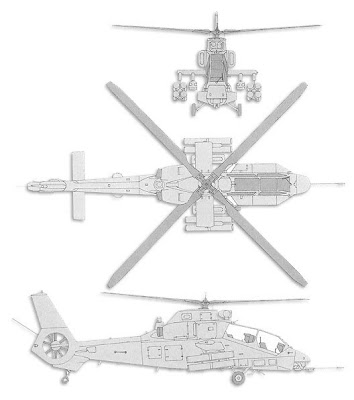
Kawasaki OH-1: Light Scout and Observation Helicopter

Kawasaki OH-1 Ninja (photo : Flugzeuginfo)

Sejak pertengahan tahun 1980-an Badan Pertahanan Jepang (JDA), mulai mempertimbangkan penerus helicopter ringan OH-6D yang saat itu masih digunakan oleh Angkatan Darat-Pasukan Beladiri Jepang (JGSDF).

undefined

3 sisi heli OH-1 Ninja (image : Militaryphotos)

Diputuskanlah untuk mengembangkan sendiri helicopter untuk peran pandu dan pengintaian (LSOH). Pada tahun 1992 Kawasaki terpilih sebagai kontraktor utama dengan bobot 60 persen dari program, sisanya dialokasikan sama antara Mitsubishi dan Fuji. Ketiga perusahaan membentuk Observation Helicopter Engineering Team untuk mengembangkan program tersebut, dan mulai bekerja pada tahun 1992.

undefined OH-1 bersenjata lengkap (photo : Military Today)

Sebagai hasilnya adalah OH-1 (diberi nama Ninja), memakai mesin konvensional yang relatif kecil dan berkonfigurasi sebagai helikopter bersenjata. Berdasarkan berat, 40 persen strukturnya terbuat dari carbonfibre-reinforced plastic, dan rotor ekor berjenis fenestron.

Perangkat dari Fujisu dan NEC terpasang di depan rotor utama (photo : Military Today)

Setiap awak memiliki dua LCD warna multi-fungsi, dan gunner memiliki head up display. Perangkat avionik termasuk trainable roof-mounted dari Kawasaki (di depan rotor utama) dengan thermal imager dari Fujitsu, kamera TV warna dari NEC dan laser rangefinder dari NEC. Perlindungan bertambah dengan pemasangan jammer infra-merah dari punggung hingga ke belakang gearbox utama.

Cockpit helikopter OH-1 (photo : Aviation-Militaire)

Prototipe pertama dari enam yang dibuat terbang pada 6 Agustus 1996, dan heli pertama dari kemungkinan 150-200 heli OH-1 diserahterimakan ke JGSDF pada 24 Januari 2000. Sebanyak 14 OH-1 telah dipesan dan diserahterimakan sebelum 2001. JDA mungkin akan menyesuaikan OH-1 untuk memenuhi kebutuhan helikopter serang ringan AH-X. Yang mendesak kemungkinan adalah mesin MTR-390 atau T800, yang memungkinkan adanya tambahan beban senjata, juga perlunya perubahan perangkat avionik. Sasaran dari produksi model AH-X adalah AH-2.

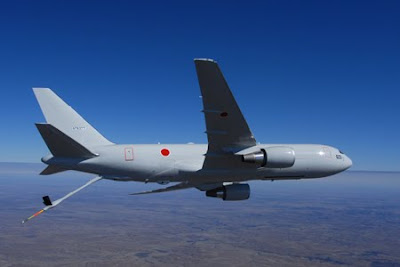
Last Japanese KC-767 Delivered

undefinedBoeing KC-767 for JASDF (photo : AviationNews)

Boeing delivered the last of four KC-767 tankers for the Japan Air Self Defence Force on January 8, a significant milestone for the delayed program, with Boeing partner Itochu Corp handing over the aircraft to Japanese Ministry of Defence officials.

The first Japanese KC-767 was handed over in February 2008, two years late due to development issues, the second in March 2008 and the third in March 2009. IOC was achieved in March 2009, while the KC-767 fleet continues to undergo operational evaluation by the JASDF, which should conclude early this year, according to Boeing. The aircraft are operated by the 1st Airlift Wing at Komaki air base.

Meanwhile, flight testing of three of the four KC-767s on order for the Italian air force continues. Deliveries of Italy’s four tankers (the fourth is currently undergoing its tanker conversion process) have been delayed over four years, in part due to a wing flutter issue. As well as a boom, Italy’s tankers, unlike Japan’s, are also fitted with hose and drogue wingtip pods and a centreline refuelling point.

Australia passed over the KC-767 in preference to the A330 MRTT (KC-30) in April 2004.

Japan's Fighter Contest Heats Up


Eurofighter Typhoon (photo : AviationNews)

TAIPEI and LONDON - After years of delay, Japan is moving forward on the F-X multirole fighter competition, and a request for proposals (RfP) could be issued as early as next month.
The F-X fills a requirement for 40 to 50 fighters to replace aging
F-4EJ Kai Phantoms; first deliveries could begin in 2015 if a decision is made this year.

Contenders include the Eurofighter Typhoon, Boeing F/A-18E/F Super Hornet and Lockheed Martin F-35 Joint Strike Fighter (JSF).

The competition has been delayed since 2007 due to budgetary constraints, political bickering and procurement scandals. The Japan Air Force also delayed the decision, hoping the U.S. would release exports of the F-22 Raptor, but production was canceled last year.

Sources indicate the RfP includes dual-engines for extended operations over water, a local role in the integration of the active electronically scanned array radar, an indigenous weapon system and licensed production by Mitsubishi Heavy Industries, which is facing a drop in work once production of the F-2 fighter ends.

F-35 JSF (photo : Locjkheed Martin)

One defense industry source in Tokyo expressed doubts that licensed production of only 40 to 50 fighters would be economically viable.

"The real challenge for the Japanese is to find work for the local industry without breaking the bank," he said. "Starting from scratch on an aircraft program like that is going to be astronomical in costs for the tooling and everything else. So who is going to start an entire assembly line for 40 to 50 aircraft? That doesn't mean they won't try to do something on the assembly of the aircraft, but licensed production is going to be expensive."

Tokyo may have to wait until the F-XX competition, the follow-on fighter competition after the F-X, for 200 to 250 fighters, which would be more cost-effective from a licensed production perspective, the source said. The F-XX competition is at least a decade away.

Despite cost challenges, all three competitors are offering local industrial participation.
"We understand that industrial base is a key element of Japan's national security posture," said John Giese, senior manager for international communications, Lockheed Martin Aeronautics. "We feel F-35 offers significant opportunities for Japanese industrial participation, both in production and sustainment."

F/A-18E/F Super Hornet (photo : Richard Seaman)

The U.S. government and Lockheed responded to Japan's formal request for F-35 data in 2007.
Giese said the selection of a fifth-generation fighter like the F-35 would be an "inflection point" that would give the Japan Air Force a "transformational capability" for the future.

Boeing is offering Japan licensed production of the Block II Super Hornet.

"We will work with Japanese industries to ensure that we provide for the licensed production of these aircraft," said Joseph Song, vice president for international business development, Boeing - Asia Pacific.

Song, along with a team from Raytheon, was in Tokyo last week to promote the Hornet.

The push to sell the Typhoon to Japan is led by Alenia, BAE Systems and EADS, which also sent a delegation to Tokyo this month to meet with industry and government officials.

The Europeans see an opportunity in Japan as the new Tokyo government grapples with Washington over the U.S. military base on Okinawa and other political issues. In 2009, the Democratic Party of Japan (DPJ) unseated the long-standing Liberal Democratic Party and has since threatened to reduce the U.S. military presence.

"For Eurofighter, it wouldn't be easy as U.S. links there are strong and deep, but there is a feeling that the offer will be evaluated in a more neutral environment," a Eurofighter industry source said. "The Eurofighter position has also been helped by the good political support for the sale from the four Eurofighter nations."

F-4EJ (photo : Yahoo.Japan)

On Eurofighter's chances, Song said Boeing had to take them seriously, "especially with the change in government, and the relationship between the DPJ and the Europeans is improving."
However, Japan has never bought European fighters, and some say interest in the Eurofighter is nothing more than a ploy.

Though the Rafale fighter will not be competing, Charles Edelstenne, Dassault Aviation's chairman and chief executive, dismissed chances Japan would buy a European fighter: "The Japanese will buy American. They say they might buy European, but that's just a way of putting pressure on the Americans."

The Japanese are looking to have the first aircraft by about 2015, and recent delays and cost overruns on the rival F-35 could make it difficult for Lockheed to make deliveries until 2020.
"The other problem for JSF is that there will be a very small, if any, role for Japanese industry in a program where supporting the local aerospace industry is a key requirement along with capability," the Eurofighter source said.

Lockheed's Giese denies the F-35 is hobbled by recent program troubles.

"The F-35 program fully meets Japan's F-X acquisition timeline and delivery requirements," he said. "The adjustments in the F-35 program have, in fact, strengthened the program for Japan."
Giese said production was on track and resources have been added to development. "The more conservative development schedule reduces concerns of programmatic risk," he said. "F-35 is on track to deliver fifth-generation fighter capability to meet Japan's requirements."

Global Hawk is Offered to Australia, Singapore, and Japan


RQ-4 Global Hawk (photo : Air Attack)

Northrop puts Global Hawk on show in Japan

Northrop Grumman has been making a major push in Japan for its RQ-4 Global Hawk in an effort to have procurement of such unmanned air vehicles included in the country's next five-year plan.

Japanese military and defence officials were able to see a full-scale model of the Global Hawk on display in Tokyo on 24-25 March. Japan was the last stop in an Asia-Pacific tour that also saw the Global Hawk model displayed in Australia, Hawaii, Guam and Singapore.

Japan's defence establishment has been studying the Global Hawk for several years and Northrop's latest marketing push comes as it works to formulate its five-year fiscal plan for 2011-15.

If Japan orders the Global Hawk it would need to get US government export approval.

"Capable of flying well above all civil air traffic at altitudes of up to 60,000ft [18,300m] for the more than 32h at a time, Global Hawk is a suitable intelligence, surveillance and reconnaissance asset for Japan," says Curt Orchard, Northrop Grumman international vice-president for Japan.

Japan has a need for greater intelligence, surveillance and reconnaissance capability because it has three potentially hostile neighbours: China, North Korea and Russia.

Tokyo and Beijing have territorial disputes over outlying islands and sea borders, while Pyongyang continues to test missiles - some of which have flown over Japan - and Moscow occupies the Kuril islands, some of which it annexed from Japan in the last days of the Second World War.

Northrop says the Global Hawk "is the only unmanned air system to receive both US Air Force and US Federal Aviation Administration certificate of authority allowing routine operation in civil air space."

The Global Hawk's range of 16,100km (10,000nm) means a single mission can span north-east and South-East Asia, it says.

Kawasaki Heavy Belatedly Delivers Its First XC2 Transport Jet to ASDF


Kawasaki XC-2 is a next generation transport jet with MTOW 120 tonnes (photo : Airliners)
GIFU (Kyodo) Kawasaki Heavy Industries Ltd. delivered its first XC2 next-generation transport jet to the Air Self-Defense Force in a ceremony Tuesday at the firm's Gifu plant, two years behind schedule.

The XC2, a high-wing twin-engine plane measuring 44 meters in length, is currently the largest domestically developed aircraft.

The delivery was delayed because the fuselage turned out to be weaker than designed. The second plane is to be delivered by the end of March 2012.

The XC2's payload is about three times larger than the C1 transport now used by the ASDF.

The XC2 is easy to fly and can have civil aviation applications, a KHI official said.

The Maritime Self-Defense Force is developing the XP1 next-generation submarine patrol plane, which will use some common parts with the XC2.
Development costs for the two airplanes combined came to ¥345 billion.

Japan Could Better Exploit its Defense Technology

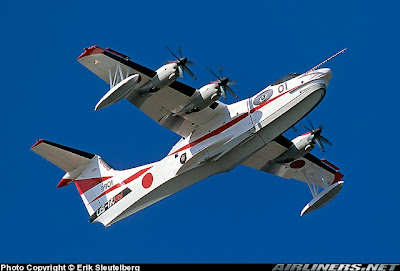
undefined Shin Meiwa US-2 (photo : Airliners)

Transfers of military technology--on a limited scale--could be an effective way to maintain the nation's vital defense technology while also supporting defense-related companies.

The Defense Ministry is studying a plan to transfer aircraft it developed to private use. The plan includes converting the Maritime Self-Defense Force's US-2 search-and-rescue seaplane to a firefighting flying boat and also converting the XC-2 next-generation transport plane now being developed by the Air Self-Defense Force to a large civilian cargo airplane.

The transfer of military technology to civilian use is unprecedented in this country. But search-and-rescue and transport planes are not really armaments in the first place. Adapting them for civilian use would have no effect on Japan's ideal as a "pacifist nation."

The government would be able to recoup some of its development costs by collecting usage fees from private companies. The procurement costs for Self-Defense Forces planes could also be reduced through the efficiencies of mass production. Manufacturers, for their part, could expect certain levels of earnings because the global demand for firefighting flying boats and cargo airplanes is large.

Kawasaki XC-2 (photo : Airliners)


Widespread benefits

Transfer of SDF technology to private use would benefit both the private and public sectors. The practice should have been promoted much earlier.

Recent years saw an increasing number of companies withdraw from the military equipment industry due to the continued decrease in defense budgets. The loss of the high-level engineers and specialized manufacturers that are indispensable for the development, production and improvement of such equipment undermines the bedrock of national security.

But at the same time, the security environment surrounding Japan has become grimmer. Under such circumstances, it is essential to maintain a foundation for defense technology even while making more efficient use of defense budgets.

In line with the revision of the National Defense Program Guidelines scheduled within this year, it is important to make a drastic review of the arms export ban.

Regarding military equipment that entails huge development costs, such as the F-35 next-generation fighter jet candidate, joint development involving two or more countries is a global trend. Japan cannot take part in such multinational projects because its principles only allow participation in such projects to be undertaken with the United States.

Review export ban principle

Japan's ban on arms exports applies to almost all nations other than the United States. The government must study limiting the ban to countries involved in international conflicts and those supporting terrorism. We suggest that Japan be at least permitted to undertake joint development of military weapons with ordinary countries and that a system be introduced to screen arms exports on a case-by-case basis.

Allowing the export of purely defensive materiel, such as mine detectors and bulletproof vests, would not harm Japan's image as a pacifist nation.

Both the Democratic Party of Japan and the Liberal Democratic Party called for transfers of military equipment to private use in their campaign platforms for the House of Councillors election in July. There could be room for cooperation beyond the framework of ruling and opposition parties on the issue of reexamining the export ban.

In the previous Cabinet under former Prime Minister Yukio Hatoyama, Defense Minister Toshimi Kitazawa expressed positive thoughts about revising the arms export ban. But the review could not take any concrete shape due to opposition from the Social Democratic Party, which was then a member of the ruling coalition.

Now that the SDP has defected from the coalition government, the political barriers to transfers of military technology appear to have been lowered drastically.

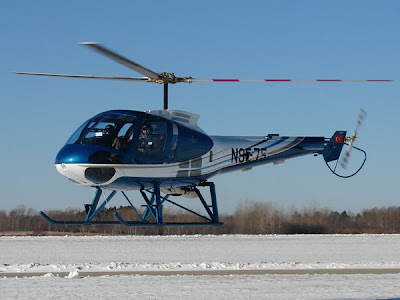
Enstrom 480B for the JGSDF First Flight

undefined
Enstrom 480D helicopter (photo : Enstrom)

Enstrom Helicopter Corp. Flies the First 480B Destined for the JGSDF Training Program

Menominee MI, August 24, 2010 – Enstrom Helicopter Corporation has completed the first day of flying for the first 480B helicopter destined for the Japanese Ground Self Defense Force (JGSDF) Pilot Training Program.

“The first day could not have gone better”, said Jerry Mullins, President and CEO of Enstrom Helicopter Corporation. “All necessary flight performance requirements were met and Production Flight Testing has been completed. We will enter into the certification phase of the testing early this week.”

The aircraft configuration procured by the JGSDF has multiple new options that were developed for this program. The industry unique 2+2 (two pilots and 2 passenger) cabin configuration was one of the major developments undertaken for the JGSDF. Certified in November of 2009, Enstrom and its Japanese representation, AERO Facility, Ltd. Inc., teamed up to develop and certify the newly configured cabin that allows two sets of controls and additional seating for two passengers. “The unique thing about this configuration in the 480B”, said Tracy Biegler, Director of Sales and Marketing, “is that both pilots and passengers are all in the same area, able to view all instruments, watch each of the pilots, and see what each other see.”

The 2+2 configuration was one of the major requirements of the program and was recognized early on as a key to success. The requested configuration was very stringent and required excellent visibility of the instruments, controls, and external views from all seats within the helicopter. Therefore, a unique cabin configuration, such as the 480B provides, was required to create a successful solution without compromise to the rest of the program. With the versatility of the Enstrom design, along with a company infrastructure designed and staffed to react quickly, the design went from concept to certification in record time.

Other items that were developed for this program are primarily special support avionics for the missions defined by the JGSDF. Certification will now drive the final delivery timing for the aircraft. It is expected that this process will be completed within the next six to eight weeks. The program calls for this first evaluation helicopter to be delivered in 2010, with a total of 30 aircraft to be delivered by 2014. Enstrom was chosen in a competitive bidding process over two formidable manufacturers in February of this year.

Govt FX Project at Standstill / Nation's Air Defense at Stake in Selection of Next-Generation Fighter Jet

undefinedBoeing has proposed F-15FX for Japan's FX programme (photo : Militaryphotos)

Government efforts to select the next generation of mainstay FX fighter jet for the Air Self-Defense Force, a decision likely to have a profound effect on the future of the nation's air defense, have come to a standstill.

The deadline to choose the successor to the ASDF's aging F-4 fighters is said to be 2016. But the Defense Ministry is likely to demand only research expenses for the FX fighter in its fiscal 2011 budget request to be submitted Tuesday. The ministry has unofficially decided to postpone the budget request to procure next-generation mainstay FX fighter jets.

The strain in the Japan-U.S. relationship caused by the ruling Democratic Party of Japan's handling of the relocation of the U.S. Futenma Air Station in Okinawa Prefecture has hampered Japan's ability to select FX fighters, observers said.
The 70 F-4 fighters currently owned by the ASDF were phased into service beginning in 1971. Many have degraded over time, and some were taken out of service as they reached their maximum permitted flight hours.

In the United States, which developed the aircraft, all F-4 fighters have been retired.

The major next-generation fighter jet candidates being studied by the Defense Ministry and the Self-Defense Forces are the F-35 jointly developed by Britain, the United States and other countries; the Eurofighter, jointly developed by four European countries such as Britain and Germany; and the F/A-18E/F of the United States. Each has its advantages and disadvantages.

Mitsubishi F-2 (photo : Wiki)

The ASDF wants to purchase the F-35, a fifth-generation fighter jet, which features mobility as well as stealth capability to evade radar detection.

The F-4 fighter, a mainstay of the 1960s and '70s, is the nation's third-generation fighter, but the ASDF hopes to make a leap straight to fifth-generation fighters.
"Russia already is conducting flight tests of a fifth-generation fighter. China also will fly a fifth-generation aircraft in the mid-2010s," an ASDF official said.

However, the U.S. Air Force is not likely to deploy the F-35 until 2015, about two years behind schedule. Accordingly, it is unclear if Japan would be able to import the F-35 by its 2016 target.

The Defense Ministry plans to seek research expenses for F-35 technology in the fiscal 2011 budget.

However, sources close to military affairs said it is questionable whether the United States would disclose top-secret information pertaining to the F-35 at a time when Japan has not definitively expressed its intention to procure the fifth-generation U.S. fighter.

Grounds for concern include the F-35's price tag of more than 20 billion yen apiece, and the potential for the jet's malfunctioning after its development.

Moreover, there is no chance the United States would allow Japan to manufacture the F-35 under license by paying patent fees, as Japan did not participate in the fighter's joint development with the U.S. and other partner governments. Therefore, the fighter's introduction would offer no opportunities for Japan's defense industry.

Currently, F-2 fighters are produced domestically, but that program will be terminated in fiscal 2011. If Japan is subsequently unable to produce next-generation fighters under license, the nation's production and technology bases would be lost.

Meanwhile, the countries developing the Eurofighter are trying to market the aircraft to Japan using a "no black box approach," meaning sensitive information would be disclosed to Japan. They say Japan would be able to develop and produce its own version of the Eurofighter without leaking the developer countries' restricted military technology.

Britain's BAE Systems PLC Vice President Andy Latham, who is in charge of Eurofighter sales, said the aircraft would be best suited to nurturing the Japanese defense industry.

The point at issue is how Japan's selection of a European fighter would affect the Japan-U.S. alliance because Japan so far has adopted U.S. forces' mainstay fighters.

According to a senior Defense Ministry official, "If the Japan-U.S. relationship had not worsened due to the dispute over the U.S. Futenma Air Station, the Eurofighter could be one of our choices [for a next-generation fighter.]"

With no decisive factor, the ministry is also considering a plan to postpone the selection and procurement of the successor fighters and simply maintain domestic production of the F-2.

Prof. Satoshi Morimoto of Takushoku University criticized the government, saying it has no basic vision for the nation's security. "I can't see that the government has any clear vision pertaining to the selection of fighters and maintenance of the domestic defense industry," he said.

Japan's Destroyer Successfull Intercept Balistic Missile

JS Myoko, a Kongo class destroyer (photo : Defense Industry Daily)

Lockheed Martin's Aegis Ballistic Missile Defense System Defeats Ballistic Missile Target in Japanese Test
KAUAI, Hawaii --- JS Myoko, Japan's third destroyer equipped with Lockheed Martin's Aegis Ballistic Missile Defense (BMD) system, successfully intercepted and destroyed a ballistic missile target above the atmosphere during a test event today. The test marked the 20th successful ballistic missile intercept by the system.

JS Myoko guided a Standard Missile (SM)-3 Block IA missile to intercept the separating medium range ballistic missile target outside the Earth's atmosphere.

Two U.S. Navy Aegis BMD ships, USS Lake Erie and USS Paul Hamilton, also participated in today's test. USS Paul Hamilton tracked the target and performed a simulated engagement. USS Lake Erie, equipped with the next generation Aegis BMD Weapon System -- designated BMD 4.0.1, which provides additional target discrimination capability -- tracked the missile target and post-intercept debris using its advanced signal processor. Full operational certification of BMD 4.0.1 is expected in 2011.

"This is the first Aegis BMD flight test conducted with two versions of the U.S. Navy Aegis BMD baselines and a Japanese destroyer," said Orlando Carvalho, vice president and general manager of Lockheed Martin's Surface-Sea Based Missile Defense line of business. "These events demonstrate the Aegis development success of build a little, test a little, learn a lot as well as the flexibility of the systems to evolve and keep pace with the threat to control the battlespace.

" The Missile Defense Agency and the U.S. Navy are jointly developing Aegis BMD as part of the United States' Ballistic Missile Defense System (BMDS). The Navy's independent operational test agent has assessed the Aegis BMD and SM-3 Block IA system to be operationally effective and operationally suitable. Currently, a total of 22 Aegis BMD-equipped warships -- 19 in the U.S. Navy and three in the Japanese Maritime Self-Defense Force -- have the certified capability to engage ballistic missiles and perform long-range surveillance and tracking missions. Two additional U.S. East Coast-based Aegis-equipped ships are being modified to perform ballistic missile defense in the next six months.

The Aegis Weapon System is the world's premier naval defense system and the sea-based element of the U.S. Ballistic Missile Defense System. Its precision SPY-1 radar and integrated command and control system seamlessly guides the interceptor and uplinks target track information to the missile for terminal homing. Its ability to detect, track and engage targets ranging from sea-skimming cruise missiles to ballistic missiles in space is proven and unmatched. The Aegis BMD Weapon System also integrates with the BMDS, receiving track data from and providing track information to other BMDS elements.

The 92 Aegis-equipped ships currently in service around the globe have more than 950 years of at-sea operational experience and have launched more than 3,500 missiles in tests and real-world operations. In addition to the U.S. and Japan, Aegis is the maritime weapon system of choice for Australia, Norway, South Korea and Spain.


See Also :

Japan Achieves Second Ballistic Missile Intercept Using Raytheon Standard Missile-3
28 Oktober 2009
Raytheon Standard Missile 3 / SM-3 (photo : Defense Industry Daily)

KAUAI, Hawai --- The Japan Maritime Self-Defense Force achieved another ballistic missile intercept in space using a Raytheon Company-built Standard Missile-3. During the Oct. 27 test, the SM-3 Block IA missile engaged and destroyed a medium-range ballistic missile target more than 100 miles above the Pacific Ocean.

Personnel at the U.S. Navy's Pacific Missile Range Facility on Kauai launched the ballistic missile target. The crew of the Japanese destroyer JS Myoko (DDG-175) detected and tracked the target before firing the intercepting missile.

"Today's hit-to-kill intercept is further proof that Japan can successfully deploy a sea-based ballistic missile defense system," said Dr. Taylor W. Lawrence, Raytheon Missile Systems president. "The U.S. has a key ally that can defend itself against the growing threat of ballistic missiles."

Raytheon and Mitsubishi Heavy Industries, under contract to the U.S. Missile Defense Agency and the Japanese Ministry of Defense, are developing the next-generation SM-3 Block IIA missile. The new missile will include larger second- and third-stage rocket motors and a larger kinetic warhead to provide a greater area of defense against more sophisticated threats.

SM-3 is being developed as part of MDA's sea-based Aegis Ballistic Missile Defense system. The missiles are deployed on U.S. Aegis cruisers and destroyers and Japanese destroyers to defend against short- to intermediate-range ballistic missile threats in the ascent and midcourse phases of flight.