Showing posts with label Tank. Show all posts

British Military Scientists Developing An Army Of Invisible Tanks

British military scientists say they're working to develop an army of invisible tanks ready for use on the battlefield within five years. The armored vehicles will use a technology known as "e-camouflage" that would let images on the vehicle's hull change to match their environment, The Sunday Telegraph reported.
Sophisticated electronic sensors attached the tank's hull would project images of the surrounding environment back on the outside of the vehicle, helping it blend into the landscape and evade attack, the report said.
Until recently such ideas were thought to be the stuff of science fiction, but scientists at the British defense company BAE Systems now think near invisibility will soon become reality.


BAE scientists are also looking at other battlefield innovations to increase troop protection while making vehicles more lethal.
Scientists at BAE are said to be close to developing a form of transparent armor -- much tougher than bullet-proof glass -- which could be used in turrets on the sides of armored vehicles to improve visibility.
A technology called "biometric integration" uses advanced computer programs to analyze crowds and search for potential threats by analyzing suspicious behavior in groups or individuals, the newspaper said.

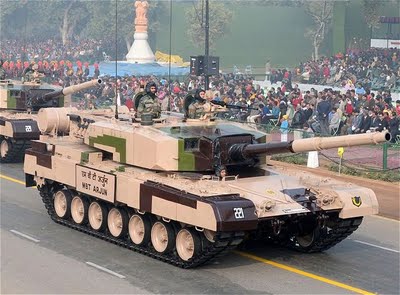
DRDO Says Arjun MkII Version Tanks Are Ready For Trials

Within a year of the government approving a project for an upgraded indigenous main battle tank (MBT), India's defence research agency has readied a Mark II version that will undergo summer and winter trials this year.

The defence ministry had last May given its nod to the Defence Research and Development Organisation (DRDO) to develop the Arjun MkII MBT which would have enhanced features over the first lot of 124 tanks that have been delivered to the army over the last two years.

'The Arjun MkII tanks will go for summer trials this year and later for winter trials at the end of 2011,' a defence ministry official said here Monday.

The army is already operating two regiments of Arjun tanks in the western sector and has placed an order for an additional 124 - two regiments - of the 58-tonne tanks from the Avadi-based manufacturer, Heavy Vehicles Factory.

The army gained confidence in operating the Arjun tanks, despite the initial hesitation, after the first two regiments were pitted against the Russian-built T-90 MBTs early last year in comparative trials in the desert terrain.

The Arjuns, army officers said, had outsmarted the T-90s in all the parameters set for the trials and had prompted the army top brass to admit that the tank was one of the best they had operated.

The Arjun MkII will have about a dozen changes from the first lot, being armed with missile firing capability through a laser homing device.

Though the missile system had been tested on the MkI version of the tank about five years ago, it did not form part of the final design of the initial 124 delivered to the army, and nor will it be mounted on the second lot of 124, ministry officials said.

The system, they said, would have a range of about eight kms, within which it could destroy enemy tanks after homing on to the target using a laser.

Other modifications include better explosive-reactive armour for the tank to protect it from enemy missiles and rockets, improving the sighting facility to provide it a wider view of the battlefield, including night vision capability, and a better communication system.

Turkey modernizes Leopard 2 tanks


Turkey's largest defense company Aselsan has completed the modernization of the German Leopard 2A4 tank, which will serve partly as a test bed for the country's planned first main battle tank, the Altay, Anatolia news agency reported Friday.
Aselsan dubbed the tank it just modernized as the "Leopard 2 Next Generation." The new tank will be displayed at IDEF 2011, Turkey's largest defense fair, which is held every two years in Istanbul. This year's event will run from May 10 to 13.
Aselsan, while modernizing the Leopard 2A4, has replaced the tank's all electronic, electro-optical, electro-mechanical and electro-hydraulic equipment with its state-of-the-art systems, the state news agency said.
Aselsan earlier modernized 171 German-made Leopard 1 tanks under a $160 million contract with the Undersecretariat for Defense Industries, or SSM, Turkey's defense procurement agency.
A state-owned company, Aselsan specializes in military electronics. Founded in Ankara in 1975, the company's 2009 revenue reached nearly $643 million.
Separately, Otokar, a private armored vehicle maker, signed two years ago a $500 million contract with SSM for the design and development of the Altay, Turkey's first indigenous main battle tank.
Otokar has a deal with South Korea's Hyundai Rotem to obtain technology transfer for the production of four Altay prototypes by the end of 2015. Several other Turkish companies, including Aselsan, are taking part in the Altay's development.
Many of the subsystems Aselsan has used to modernize the Leopard 2A4 will be included in the Altay.
Israel's Israeli Military Industries, or IMI, had upgraded the Turkish Army's 170 U.S.-made M60 main battle tanks for nearly $700 million. IMI, which worked with several Turkish partners including Aselsan, delivered the last upgraded M60 to Turkey about a year ago.
But IMI's upgrade of the M60s and Aselsan's modernization of the Leopard 1 are different matters. The first deal included major armor, fire control and engine progress, while the second project included the replacement of fire control systems only.


source

DRDO Says Development of Improved Indian Arjun Complete


India's state-owned Defence Research and Development Organization (DRDO) claims that it has completed upgrades on the Arjun tank, replacing existing German engines and transmission systems with homemade systems.

The Mark-II Arjun will incorporate up to 90 percent of indigenous content, compared with 58 percent in the current model, a DRDO scientist said, and should be ready for induction by 2014.

The Mark-II also will feature superior missile-firing capabilities, the scientist added.

 Conceived in 1973, the Arjun tank was behind schedule by more than 15 years, resulting in the Indian Army choosing the Russian T-90 tank as its main battle tank. The Arjun had to go through a series of trials and retrials before the Army announced the tank fit for duty. Last year, the Arjun Mark-I had to be put on comparative trials against the Russian T-90, after which the Indian Army finally concluded that the Arjun tank performed to expectations.


Earlier, the Arjun faced problems concerning its fire control system and suspension, and its weight-restricted mobility.

Last year, the Indian Army ordered an additional 124 tanks, bringing the total to 248.

Advanced Version of MBT Arjun Mark-II To Undergo Serial Production in 2014


After more than 90 upgrades, an advanced variant of the indigenous Main Battle Tank (MBT) Arjun will undergo serial production in 2014.
The tank, Arjun Mark-II, will be equipped with an indigenous engine a year after the start of its serial production to replace its German power plant, Defence Research and Development Organisation (DRDO) officials told PTI.
"The advanced Arjun will be equipped with Explosive Reactive Armour and missile-firing capability from its main gun and better night-vision capabilities," they said.


The officials said that the gear box of the tank too would be upgraded to improve its performance.

Meanwhile, the DRDO has decided to go ahead with the first phase of the tank''s trial in June this year. "The user-Indian Army- would be involved in the trial from the phase one itself. The second phase would take place sometime early next year," said the officials.

124 Arjun Mark-I tanks, comprising two regiments, have already been inducted into the Army after being manufactured in Heavy Vehicles Factory (HVF) in Avadi. The regiments are based in the western sector.

PLA Decommissioning of The Type 62 light tanks


PLA has finally ready to retire it's Type62 fleet.

New Sino-Pak Main Battle Tank In Planning

China and Pakistan have planned a packed schedule of military exchanges for this year, marking the 60th anniversary of their diplomatic relations.

This will include two Chinese naval visits to the Pakistani port city of Karachi in August and October and two joint military exercises, said Khalid Shameem Wynne, chairman of Pakistan's Joint Chiefs of Staff Committee.

In addition to the two bilateral army and air force exercises, the two countries will also participate in a multinational naval drill next month, according to the senior military official.
"Another joint counter-terrorism exercise is set to be held in Pakistan next year," he said, noting the two countries are working to make it an annual event. A similar drill, led by Wynne, was conducted in northwestern China's Ningxia Hui autonomous region last year.

"We are looking forward to further interaction with the People's Liberation Army (PLA)," Wynne said. He said the two countries are moving forward in the joint development of sophisticated weapons systems, including tanks.

The general expressed his satisfaction with the JF-17 Thunder aircraft program, jointly developed by China and Pakistan, saying that this is one of the leading combat aircraft in the world.

The JF-17 program is one of the biggest joint projects taking place between the two strategic partners.

Wynne on Sunday wrapped up his five-day China visit, which took him to Beijing and Shanghai.

His major purpose in visiting the country was to co-chair the Eighth Sino-Pakistani Defense and Security Talks with PLA Chief of General Staff Chen Bingde.

Wynne, who was visiting China for the first time since he was promoted to the rank of general and assumed his present position in October 2010, termed the China-Pakistan bilateral strategic relationship as a "stabilizing force" in the region.

During his stay in Beijing, he met Vice-President Xi Jinping and Minister of National Defense Liang Guanglie and both sides reaffirming their determination to consolidate their "all-weather" friendship and deepen pragmatic cooperation.

Russian Ground Troop Says Chinese Arms Better Than Russian Arms


The Russian defense industry manufactures poor quality arms for ground forces. NATO and China produce better quality hardware, the commander of Russian ground troops Alexander Postnikov said.

"The combat vehicle arsenal, artillery systems and small arms produced by the domestic defense industry fall behind NATO and even Chinese arms," the official stated.
 

Postnikov particularly cracked down on the Russian T-90 tank, which, as he said, "was a 17th modification of the Soviet T-72 tank produced since 1973. According to the official, a tank like that currently costs 118 million rubles ($4 million). "It would be easier for us to purchase three Leopards from Germany for this money," he said.

He did not explain, though, why India prefers to buy one Russian T-90 tank instead of three German Leopards. India plans to use T-90s to replace its outdated T-72 and T-55 tanks. Algeria, Saudi Arabia and Turkmenistan also signed contracts with Russia for the delivery of such machines, but Mr. Postnikov disregarded that too.


There are other interesting aspects to the story. According to media reports, in 2010, one T-90 tank was valued at 70 million rubles ($2.3 million). Therefore, it is not clear how the cost increased more than 1.7 times in less than a year.

Here is another aspect. Cheapest and oldest Leopards cost not less than 70 million rubles as of 2009. As for Leopard 2A6, the cost of this machine is 172.2 million rubles ($5.7 million).

It is worthy of note than 80 countries of the world purchase arms from Russia today. The volume of Russian arms sales grows every year by $600 million. However, according to Mr. Postnikov, all these countries buy outdated and extremely expensive hardware. Moreover, Russia's arms sales in 2010 were evaluated at $10 billion vs. $8.8 billion earned in 2009, Rosoboronexport said.

Do the governments of 80 countries purchase Russian arms to cause damage to their own detriment? Nevertheless, it is not the first time, when officials from the Russian Defense Ministry express negative remarks about the quality of domestic military hardware.

It was particularly said, for instance, that Russia would launch the license production of Italian Iveco Lynx armored vehicles in 2011. No one could prove, though, that Russian analogues of those vehicles are worse.

Vladimir Popovkin, first deputy defense minister, complained of the poor state of affairs in the development of Russian unmanned aircraft. Russia spent five billion rubles for the purpose, but failed to achieve any progress, the official claimed.

Alexander Postnikov, the commander of the Russian ground forces, said in September of 2010 that his troops had completed test flights of 22 Russian drones. The designers achieved impressive progress, Postnikov said and added that some drones could be put into service soon.

These are contradictory statements, but it seems that Russia is not going to refuse from purchasing the drones of Israeli production.

The most controversial statement was released by Defense Minister Anatoly Serdyukov in December of 2010. He stated that Russia could replace its iconic Kalashnikovs and SVD rifles with foreign analogues.

Vladislav Shurygin, a military expert:

"Those saying that the production of the Russian defense industry is worse and more expensive than Western and even Chinese analogues need to have their heads examined. Such remarks can bury all our defense contracts, so they are voiced by those who should be considered as enemies of their own country.

"As for the condition of the national defense industry, it is a very complicated one indeed. Russia has been living on the Soviet legacy during the recent 20 years. We have not been investing anything in the modernization of our defense industry. As a result, one can hear some people saying that Russia is incapable of building high-quality arms. However, T-90 tanks are not outdated. This vehicle operates perfectly under the conditions of the Russian climate. No one can give guarantees that foreign tanks will do well in low temperatures.

"As for the quality, it has decreased too. For example, the quality of armor that is produced today is lower than the quality of Soviet armor produced during the 1980s. Russia lost many technologies during the period of so-called democratic reforms.

"If we start to purchase hardware from abroad, we will go back to the level of the 19th century. We will not be able to defend our national interest," the expert said.
Nikolai Novichkov, editor-in-chief of Arms-Tass news agency:

"I believe that Postnikov has a point. President Medvedev stated several days ago that there were no qualified engineers left in the country. Instead, we have the multi-million-strong army of managers and lawyers, he said. One should think about that when analyzing the situation in the Russian defense industry. Many employees working at our defense enterprises are in their fifties and sixties. Young people do not go to work in the defense industry, because they pay about 15,000 rubles there ($500) a month. If someone comes to work there, they soon leave to work as managers to get more money," Novichkov said.

Al-Khalid, Type 98 and T-90 Will Dominate The World Tank Market Till 2018


In its annual analysis "The Market for Tanks," the Forecast International Weapons Group projects that the international market will produce over 6,500 main battle tanks, worth in excess of $26.76 billion, through 2018. However, while increased modernization and retrofit remains transparent to FI’s analysis of new-production tanks, this factor remains a significant component of the international market.

Dean Lockwood, weapons systems analyst at Forecast International, notes that "in 2008, U.S. Department of Defense contract awards for the maintenance, RESET, and upgrade of the existing M1 Abrams inventories carried a total value in excess of $1.46 billion. That was equivalent to more than 46 percent of the total value of all new-production main battle tanks entering the international market in 2008 (nearly $3.17 billion). Last year, the Chinese Type 98 program maintained its position as the single largest new-production program. Yet, with a total value of $395.79 million (for 116 new-production tanks), the Type 98 program was worth only about 27.11 percent what the U.S. DoD spent on the M1 Abrams in 2008."


The expense associated with the modernization and retrofit of high-end main battle tanks pales in comparison with the prospect of new tank procurement. Thus, FI expects new production of high-end tanks to remain relatively low, accounting for 14.9 percent of all production and 24.22 percent of the value of the market during the forecast period. 


In terms of sheer numbers, Forecast International expects Pakistan’s Al Khalid, the Type 98 of the People’s Republic of China, and the Russian Federation’s T-90 (including India’s licensed T-90S production program) to continue to dominate the market, representing 60.57 percent of all new tanks rolling out worldwide, and accounting for 52.28 percent of the value of the market, through 2018.


In the international market for main battle tanks, the days of U.S. and European domination over new production are long gone. Nevertheless, the established U.S. and European players continue to make their presence felt. The 120mm Rh 120 smoothbore ordnance, the state-of-the-art Leopard 2, and the combat-proven M1 Abrams continue to set the standard for main battle tank design worldwide.


Second only to the infantryman in terms of combat effectiveness, the "mailed fist" of heavy armor remains the arm of decision on the modern battlefield. Further, as Operation Iraqi Freedom (2003-present) evolved from a war of movement into a security operation, the main battle tank has proven surprisingly adaptable. According to Lockwood, "In the congested streets of Iraqi cities, the Abrams serves as a significant force multiplier, fully up to meeting the challenges of an asymmetric warfare environment."

Indian Army To Get Explosive Reactive Armour For T-72 Tanks


Type 96G The Core of the PLA Armored Divisions


Currently there are only around 500 type 99 of all variant and likely less than a thousand will be build.

The type 96 while less advanced is the primary main battle tank of the PLA with 1,500 to 2,500 of all variants in service and is still being produced.

The type 96G has thermal sights shared by the commander and gunner while all three crew have night vision. The commander can target for the gunner, giving the type 96G hunter killer capabilities.

The main gun of the type 96G is the same as the type 99G capable of firing depleted uranium APFDS and AT 11 missiles.

The armor is thinner but its just as advanced as the type 99 armor.

Its also air transportable.

Russian Army To Get New Generation Armada Tank By 2015


The Russian army is to be equipped with a new generation tank by 2015, and according to the Russian press, work on the new armoured  tank code named “Armada” is well in progress.
The new tank is to have new electronic equipment and the crew will be protected by internal turret.  The Armada will be different from the present T-90  in use by the Russian army, says Victor Litovkin, of the “Independent Military Review” paper. He gave an interview to VOR:
"There is a need to fit the tank with a new engine to make it more powerful and faster and easier to operate. It should be able to carry more arms and will also be protected against all kinds of explosives and ammunition. Second, it should be armed with more powerful guns and of course, it should have the necessary electronic gadgets and onboard information control complex."
The new “Armada” is designed to separate the crew from the arms by a special capsule, since protecting the crew is a high priority. The planned changes will enable the “Armada”  to compete  favourably with the leading foreign analogues, Litovkin said:
"The Western  tanks - “Leclerk”, “Leopard”,”Abrahams” and t he  Israeli “Merkava” have their advantages and shortcomings, the major one being  that they are all  heavier than the T-90 by at least ten tons. It means that they are l ess  maneuverable and are more vulnerable. On the other hand, they have thicker armoured plate and more powerful ammunition."
There are no alternatives to tanks at the present time, experts say, debunking the assertion by the skeptics about the imminent replacement of tanks by more sophisticated and  advanced weapons. The latest conflicts, including the coalition operation in Iraq have confirmed the  indispensability of  tanks in modern-day war. Tanks played a major role during the conflict in the Caucasus, especially in South Ossetia.  Experts say that tanks have been and will  remain the main striking force in any large scale land warfare.

Turkeys National Tank And Male Uav Tiha In IDEF- 11


Germany to sell 200 Leopard 2A7+ tanks to Saudi Arabia

Germany has allowed the sale of 200 Leopard tanks to Saudi Arabia after decades of blocking heavy weapons sales to the kingdom, the Der Spiegel said Saturday.
The federal security council approved the sale last week, the weekly news magazine said without citing sources.
The Saudis want to buy 200 Leopard 2A7+ tanks in an order potentially worth billions of euros to companies Kraus-Maffei and Rheinmetall, Der Spiegel said.
The kingdom was in talks with the Spanish subsidiary of General Dynamics about buying their version of the Leopard tank, but the major portion of the order will land with the Germans, the magazine said.
Since the 1980's, Germany has blocked the sale of Leopard 2 tanks to Saudi Arabia, afraid the equipment would be used against Israel.
The Saudis are also in talks with US companies for 60 billion dollars worth (41 billion euros) of defence equipment that would become the largest US contract ever.
The order is to include 84 new F-15 fighter jets and 178 combat helicopters.
Read More At:
http://www.google.com/hostednews/afp/article/ALeqM5hRrwxD2eDObBnUNuj8hru0Mxs92w?docId=CNG.8afa091e5483810446b19e5247e325f9.7e1

Army set to place order for 248 more arjun main battle tanks

The much-maligned Arjun Main Battle Tank is poised to get a fresh lease of life, with the Indian Army set to order 248 more of India's first indigenously-built tanks, a decision that will also give a much-needed shot in the arm to the country's beleaguered tank fleet.

"We are definitely expecting more orders, at least a minimum of 248 tanks of the Mark-II version. The Ordnance Factory Board has been instructed by the ministry of defence to initiate action for the procurement of the Mark-II version," P. Sivakumar, director, Combat Vehicles Research and Development Establishment, told the Economic Times.

The order, which could be placed in late-2011 itself, will come as a huge boost to the Arjun production line at the Heavy Vehicles Factory at Avadhi, on the outskirts of Chennai, as the same was expected to be terminated due to a lack of interest shown by the Indian Army.

So far, the Army has placed an order for 248 tanks of the Mark-I and Mark-II versions.

The Mark-II version of the Arjun MBT is currently undergoing its critical summer trials in Pokhran, Rajasthan, conducted by the country's nodal defence lab, DRDO, while the winter trials are expected to take place later in the year. The defence research establishment expects to get the new orders from the end user - the Army - once the current trials conclude.

"If the trials go well, particularly relating to missile firing, there is no doubt that further orders will be placed. There is a commitment given by the deputy chief of Army staff, if the new improvements are incorporated successfully" Sivakumar said.

The June trials have already seen the Arjun MBT Mark-II tested with a number of technical improvements, including command panoramic sight and uncooled thermal image. According to Sivakumar, a further 40 technological improvements are to be tested, including a new transmission control system and new fuel tanks.

'We are planning the first phase of the end user trials by October or November for the missile and other design improvements," he said.

The Army's decision to induct greater numbers of the Arjun MBT is a significant turnaround from its earlier reluctance to do so. However, with the military's 4,000-strong tank arsenal consisting largely of more than 2,400 obsolete T-72 tanks and transfer of technology issues with Russia relating to the T-90, has forced it to take a re-look at the Arjun.

The tank has had its fair share of detractors within the country's military establishment.

After being in development hell for more than 30 years and at a substantial cost of Rs 300-crore, the Arjun MBT programme had come under severe flak for cost overruns and its failure to meet the Indian Army's combat requirements, leading to speculation that it could never be the mainstay of the Indian Army's Armoured Corps.

But ever since comprehensively outgunning and outrunning the T-90, India's current flagship battle tank in 2010, the DRDO has been positioning the Arjun MBT as the backbone of the country's armoured fighting units.

Defended the programme, the defence establishment also laid part of the blame for the project delays on the Indian military , stating that they had to be "realistic" in their demands.

"'But while we welcome all inputs and guidelines, we also feel the need for the Services to firm up realistic requirements at the earliest, so we may properly plan our project requirements," Dr VK Saraswat, scientific advisor to the defence minister said last month.
 Read More AT:

http://economictimes.indiatimes.com/news/politics/nation/army-set-to-place-order-for-248-more-arjun-main-battle-tanks/articleshow/9119089.cms

Russians military denies existence of new Super-Tank


MOSCOW, (RIA Novosti) - The Russian military has denied the existence of a new-generation main battle tank (MBT) based on T-80 design and featuring explosive reactive armor and a box-shaped turret.
The Russian media has recently resumed discussion of the secret tank, dubbed Black Eagle, which was developed by the Omsk Transmash design bureau and whose pictures were shown in several publications and on the Internet.

"There was no such project...and those 20-year-old pictures show a mock-up of a futuristic tank which remained just a product of someone's imagination," Col. Vladimir Voitov, head of research at the Main Directorate of the Armored Troops, said in an interview with the Echo Moskvy radio on Saturday.
He added that he was aware of a prototype of an experimental tank, but insisted that 'the turret of the vehicle did not have anything inside."
According to the Russian media, an early prototype of the Black Eagle was shown at an arms exposition in Siberia, in June 1999. It appeared to be based on a lengthened T-80U hull, and to have very thick front armor and new-generation Kaktus explosive reactive armor.
However, recent reports in open sources suggest that the Black Eagle program has been halted due to the acceptance of the T-90, built by the Uralvagonzavod plant, into the Russian military in the mid-1990s.
In addition, Russia has reportedly opted for Uralvagonzavod as the developer and manufacturer of a new-generation MBT, which will most likely have a designation as T-95.
Sergei Mayev, head of the Federal Service for Defense Contracts (Rosoboronzakaz) told a news conference in July 2008 that the Russian Armed Forces would start receiving new-generation tanks superior to the T-90 main battle tank after 2010.
The new tank will feature better firepower, maneuverability, electronics and armor protection than the T-90 MBT.
Its speed will increase from 30-50 kph to 50-65 kph (19-31 mph to 31-40 mph).
According to some sources, the new tank may be equipped with a 152-mm smoothbore gun capable of firing guided missiles with a range of 6,000-7,000 meters.
In comparison, the T-90 MBT has a 125-mm 2A46M smoothbore gun, which can fire AT-11 Sniper anti-tank guided missiles with a range of 4,000 meters.

Advanced Version of MBT Arjun Mark-II To Undergo Serial Production in 2014


After more than 90 upgrades, an advanced variant of the indigenous Main Battle Tank (MBT) Arjun will undergo serial production in 2014.The tank, Arjun Mark-II, will be equipped with an indigenous engine a year after the start of its serial production to replace its German power plant, Defence Research and Development Organisation (DRDO) officials told PTI.
"The advanced Arjun will be equipped with Explosive Reactive Armour and missile-firing capability from its main gun and better night-vision capabilities," they said.

The officials said that the gear box of the tank too would be upgraded to improve its performance.


Meanwhile, the DRDO has decided to go ahead with the first phase of the tank''s trial in June this year. "The user-Indian Army- would be involved in the trial from the phase one itself. The second phase would take place sometime early next year," said the officials.
 
124 Arjun Mark-I tanks, comprising two regiments, have already been inducted into the Army after being manufactured in Heavy Vehicles Factory (HVF) in Avadi. The regiments are based in the western sector.

Arjun Mk-2


Second generation of Arjun Mk-2 has been cleared recently by the Ministry of Defence and funding allocated , while the Army has ordered more 124 Arjun Mk-1 to keep the production line in Avadi busy till the Arjun Mk-2 will start rolling out from 2013-14 onwards .
  DRDO rather than starting all over again the Arjun MK-2 will have the same design of Arjun MK-1, but major changes are planned for the new generation variant of Arjun Tank to keep up with the new technological changes which are been incorporated in the MBT’s world over .
Arjun MK-2 will have Battle Field Management System (BFMS) which will enable the tank to get feed from UAV‘s and Helicopters, which then enable the Arjun mk-2 tank crew much aware of their surroundings and better understanding of the battle zone, this will lead to improvement in coordinating with other Friendly tanks in the zone and also avoid Friendly kills, it will also give information regarding enemy tank movement along with their troops and help navigate terrain in the battle zone.
Self-diagnostic system (SDS) will also be added to Arjun Mk-2 which is like a health monitoring system. it will not only tell the tank crew if it is having any problem but also point out the trouble area , it is also important when Tank has taken multiple hits from different position and from different ammunition after a self-diagnose Tank crew will know exact damage inflicted on the Tank .

Arjun Mk-2 will get a new efficient 1500bhp engine which has been in development by DRDO in India its self, they are reports that a Indian Private industry is also working with DRDO on the engine development, currently Arjun MK-1 is powered by German supplied 1400bhp engine which is quite old in design and technical parameters but still a powerful and respected engine in the world.

NERA (non-explosive reactive armor) will be added to Arjun Mk-2 this will give the tank additional protection against anti-tank munitions, unlike ERA, NERA will enable tank to take multiple hits anti-tank munitions, but also increase the weight of Arjun MK-2 to 60 tons from its current weight (Arjun MK-1) of 58 tons.

It is much likely that Arjun Mk-2 will also spot Air-conditioning system for the crew, which will be powered from an APU which will draw its power from the Main engine of the Tank; this will enable the tank crew to operate in higher temperature of desert heat without any discomfort to the tank crew, Arjun MK-1 already has hardened electronics that function perfectly even in the Rajasthan summer without requiring any Air-conditioning system.

More changes will take place in Arjun Mk-2, above mentioned are mostly likely changes which will take place in the new variant.

Sri Lanka Buying Al-Khalid Tanks from Pakistan


Enhanced defence cooperation between Pakistan and Sri Lanka is likely to be finalised during Pakistani President Asif Ali Zardari’s three-day official visit to Sri Lanka, later this month.

Diplomatic and government sources said that there was a wide scope for enhanced military ties between the two nations and it would be explored during talks between Zardari and his Sri Lankan counterpart, President Mahinda Rajapaksa.

"With the defeat of the Liberation Tigers of Tamil Eelam (LTTE), the nature as well as scope of defence cooperation is bound to change somewhat, but in a broader sense it would include military training, intelligence sharing, arms supplies, etc.

Pakistan has already proposed a futuristic defence cooperation agreement. As one of the largest suppliers of high-tech military equipment, Pakistan played an important role in assisting Sri Lanka defeat the LTTE," source said.

Pakistan is said to have the largest conventional arms and ordnance facility, which provides several varieties of armaments for export. These include infantry weapons, anti-aircraft and artillery ammunition, tank and aircraft ammunition, rockets and aerial bombs.

"The shopping list included 22 Al-Khalid tanks worth US$ 100 million and weaponry totalling about US$ 65 million. The inventory for the army was worth US$ 25 million and US$ 40 million for the Air Force. 250,000 rounds of mortar ammunition costing US$ 25 million and 150,000 hand grenades were also purchased.
Last year one ship weaponry loads was sent to Sri Lanka every 12 days to bolster the assault on the LTTE’s headquarters in Killinochchi," he said.
Talks between Zadari and Rajapaksa, would also cover trade, investment, economic cooperation, tourism, culture and media, the sources said.

DRDO Says Arjun MkII Version Tanks Are Ready For Trials


Within a year of the government approving a project for an upgraded indigenous main battle tank (MBT), India's defence research agency has readied a Mark II version that will undergo summer and winter trials this year.

The defence ministry had last May given its nod to the Defence Research and Development Organisation (DRDO) to develop the Arjun MkII MBT which would have enhanced features over the first lot of 124 tanks that have been delivered to the army over the last two years.


'The Arjun MkII tanks will go for summer trials this year and later for winter trials at the end of 2011,' a defence ministry official said here Monday.


The army is already operating two regiments of Arjun tanks in the western sector and has placed an order for an additional 124 - two regiments - of the 58-tonne tanks from the Avadi-based manufacturer, Heavy Vehicles Factory.


The army gained confidence in operating the Arjun tanks, despite the initial hesitation, after the first two regiments were pitted against the Russian-built T-90 MBTs early last year in comparative trials in the desert terrain.


The Arjuns, army officers said, had outsmarted the T-90s in all the parameters set for the trials and had prompted the army top brass to admit that the tank was one of the best they had operated.


The Arjun MkII will have about a dozen changes from the first lot, being armed with missile firing capability through a laser homing device.


Though the missile system had been tested on the MkI version of the tank about five years ago, it did not form part of the final design of the initial 124 delivered to the army, and nor will it be mounted on the second lot of 124, ministry officials said.


The system, they said, would have a range of about eight kms, within which it could destroy enemy tanks after homing on to the target using a laser.


Other modifications include better explosive-reactive armour for the tank to protect it from enemy missiles and rockets, improving the sighting facility to provide it a wider view of the battlefield, including night vision capability, and a better communication system.