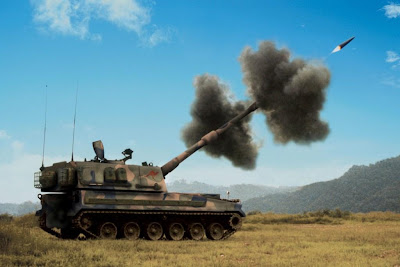
Showing posts with label Self-Propelled Artillery. Show all posts

S Korea May Clinch Australian Self-Propelled Guns Deal

undefinedAS-9 based on Samsung's K-9 Thunder-155mm self propelled howitzer (photo : Raytheon)

South Korean firm Samsung Techwin, in partnership with US company Raytheon, is expecting to clinch a AU$450m deal to provide the Australian Army with 18 155mm self-propelled artillery systems.

The company expects to clinch the deal after a consortium led by a German firm Krauss-Maffei Wegmann failed to participate in final tender negotiations with the Australian Government.

The German firm, in association with BAE Systems Australia, was seeking to supply its PZH-2000 guns.

undefinedRaytheon Australia has teamed with South Korea’s Samsung Techwin to offer the AS-9 Aussie Thunder. Based on the next generation K9 Thunder 52 calibre 155mm SPH, AS-9 brings a battle management system fully compatible with the Australian Army’s standard 155mm ammunition, support for planned special munitions such as Excalibur, and proven integration with Raytheon’s Advanced Field Artillery Tactical Data System/AFATDS. (image : Raytheon).

The Samsung-Raytheon team is offering a modified version of the K-9 weapon. The K-9, an indigenous all-welded steel armour construction rated to withstand impact by 14.5mm armour piercing shells, has been developed jointly with the state-funded Agency for Defence Development.

The self-propelled artillery system carries a 155mm/52 calibre gun with a maximum firing range of 40km and includes a 1,000-horsepower engine and a hydropneumatic suspension unit.

The government is expected to announce a final bidder as early as September, an official of the Defence Acquisition Programme Administration said.

Sights on Howitzer Sale

Nexter Caesar (photo : norev)

PETALING JAYA: Foreign arms manufacturers are eyeing a possible tender to supply the Malaysian army with up to 18 self-propelled howitzers (SPH). An SPH, or artillery, is mounted on a tracked or wheeled motor vehicle. An armoured tracked SPH usually resembles a tank.

The Malay Mail was informed by defence industry sources that at least four manufacturers were eyeing the programme which is expected to be funded under the 10th Malaysia Plan.

The SPH programme was included in the two previous Malaysian plans but procurement was never finalised due to budget cuts and other priorities. However, there has been no official word from the Defence Ministry or the army on the matter.


BAe-Bofors Archer (photo : bofors)

The lack of official announcement has not stopped manufacturers from promoting their products, leading to speculation that a tender will be called soon.
At the recent Eurosatory land defence exhibition in Paris, a Malaysian army delegation was extensively briefed by exhibitors displaying their SPHs.

Our army, which operates up to 30 G5 and FH-70 towed 155mm howitzers, purchased some 30 years ago, reportedly hoped to procure 18 SPHs to form a single battalion for its armoured brigade.

Among the four interested manufacturers reportedly eyeing the SPH tender were Sweden's Bae Systems Bofors Archer, France's Nexter Caesar, Germany's KMW PzH 2000 and South Korea's Samsung Techwin K9 Thunder.
Both the Archer and Caesar are truck-mounted SPHs while the German and Korean contenders are tracked vehicles.

K-9 Thunder (photo : military today)

In recent years, the trend for SPHs has progressed towards truck-mounted vehicles as exemplified by Archer and Caesar as they are considered more mobile than their tracked counterparts. Being truck-mounted, these vehicles also offer lower maintenance and life-cycle costs, and an extended service life.
The Archer has a combat weight of 30 tonnes while the Caesar has a relatively lower weight of 17 tonnes. The PzH 2000 combat weight is 53 tonnes while the Korean entry comes in at 49 tonnes.

Although both the Archer and Caesar may suit the Malaysian army requirements better compared with tracked vehicles, they reportedly cost US$10 million (RM32 million) and US$5 million each, respectively, mostly due to the limited number of units.

Only 48 Archers have been procured so far, all of which were ordered by the Swedish and Norwegian armies, while up to 200 units of the Caesar have been ordered by the French, Thai and Saudi armies.

PzH 2000 (photo : military pictures)

The PzH 2000 reportedly costs US$4.5 million each although the ones being offered to Malaysia are completed vehicles which were used by the Dutch army may have brought down the price.

The Thunder is probably the cheapest contender with a reported per unit cost of US$3 million although it also comes with supply vehicles designated K10 Armoured Resupply Vehicle (ARV). The ARV, which uses the same chassis, is responsible for re-arming the K9.

South Korean SPH battalions with 18 Thunder also operate 18 K10s. Some 550 K9 Thunder have been procured by the South Korean and Turkish armies. Turkey locally manufactures the Thunder under the designation T-155 Firtina.

Denel G6-52 (photo : military today)

Apart from those four manufacturers, Denel of South Africa is also expected to enter the fray when the tender is offered. The South African firm is expected to offer its G6-52 wheel chassis SPH. The G6 reportedly costs around US$4 million per unit.

Questions Over Land 17's Future


The PZH2000, from KMW in consultation with BAE Systems, and the Raytheon Australia/Samsung Techwin AS-9 are in the running for Land 17 artillery replacement program. (photo : Raptor4333 & Militaryphotos)

As Prime Minister Gillard questions the value of Abrams tanks in Afghanistan recently, others are wondering what is happening with the selection of self-propelled 155mm artillery under Land 17 and their potential for fire support to the ADF in the MEAO.

Rather than announcing a preferred bidder after what would seem to be a fairly exhaustive and longwinded evaluation phase since tenders closed in April 2008, Defence has arranged a further offer definition and refinement process (ODRP).

While Raytheon offering the AS-9 complied, KMW in consultation with BAE Systems declined to participate in the process, disagreeing with the terms and conditions of the ODRP.


Nevertheless their tender was not withdrawn and as far as KMW was concerned it stood.
Now there are dark rumours that the SPH requirement will not be considered in the latter half of 2010 – when tender validity in both cases will have run out – and that the requirement will be shelved until 2012 when it will again come up for consideration.

By then the Government may well have second thoughts about the need for heavily armoured, tracked, self-propelled heavy artillery, and how relevant such systems might be in the context of contemporary warfighting experience and future hostilities.

In which case it might invoke the balance of the M777A2 lightweight towed gun systems approved by Congress in mid-2008 for sale to Australia and thus satisfy the ADF’s requirement for 155mm gun systems, able to fire the most advanced ammunition types, and fully networked with the AFATDS command and control system.

China Upgrades Self-Propelled Artillery

undefinedChina's PLZ-05 self propelled howitzer (photo : Army Recognition)

China has deployed a fifth battalion of its new 35 ton PLZ 05 self-propelled howitzers. Each battalion has three batteries, of six howitzers each. There is also a support battery for carrying more ammo and for equipment maintenance. There is also an artillery spotting radar and a weather radar (to improve the accuracy of unguided shells). At least four other battalions have entered service since 2007.

The PLZ 05 is a further development of the 33 ton PLZ 45, which entered service in the 1990s as an export item. This system had a crew of five and a semi-automatic loader. The PLZ 04/04 use an automatic loader, thus a crew of only four is required. Kuwait, Bangladesh and Saudi Arabia bought PLZ 45s in the last decade.

Dimensions of both vehicles are 10.5 meters (1 meter=3.1 feet) long, 3.3 meters wide and 2.6 meters high (3.5 meters if you include the 12.7mm machine-gun usually mounted on top of the turret.) The PLZ 05 barrel is 15.5 percent longer than the one on the PLZ 45.

There is another model, the PLZ 04, with a slightly (4 percent) longer barrel than the PLZ 05. For all of these vehicles, the 155mm barrel is good for about 2,500 rounds. Computerized control systems and satellite navigation enable the weapon to be ready for firing within minutes. The vehicle carries 30 rounds of 155mm ammo, with 24 ready to be used by the autoloader. Max rate of fire (for a few minutes) is ten rounds a minute (five in the PLZ 45). Max range of the howitzer is 50 kilometers (with rocket assisted shells). Normal shells are good got about 39 kilometers and laser guided shells for 20 kilometers. All three of these systems use a lot of technology stolen from the Russians.

The Russian and Chinese systems compete with the fifty year old U.S. M-109 design, which is a 25 ton vehicle with a crew of five.